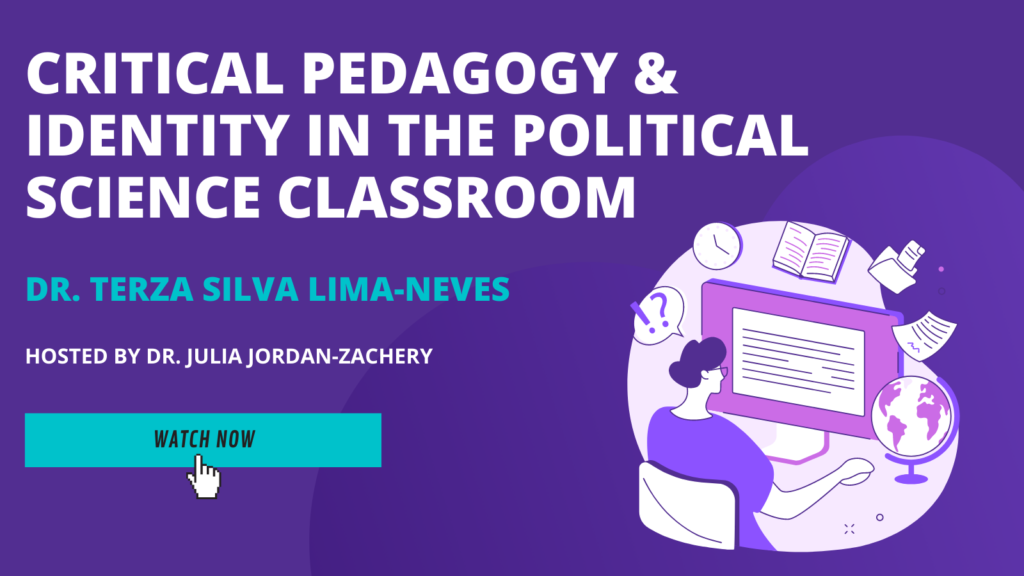
What is critical pedagogy? How do political science educators address identity, race, class and sexuality in the classroom? How and what materials do we bring to the political science classroom to encourage students to make connections and see themselves in the world? And how does our own identity as political science educators influence our…

What is critical pedagogy? How do political science educators address identity, race, class and sexuality in the classroom? How and what materials do we bring to the political science classroom to encourage students to make connections and see themselves in the world? And, how does our own identity as political science educators influence our decision…

Gary King, PhD, Department of Government, Harvard University Editor’s note – This essay is our adaptation to a longer working paper, “Education and Scholarship by Video,” written by Gary King. You can view the entire essay here. Part of the original essay includes discussion on best practices to produce and edit educational and research videos,…
Call For Materials – New Approaches to Political Science Education APSA Educate invites submissions of teaching and learning resources showcasing new approaches to political science education. Political scientists have responded to the past decade’s political, economic, social, technological, and biological upheavals by rethinking many disciplinary assumptions. At the same time, these events have altered how…
Joanna Kenty, PhD, The Citizens Campaign A lot is going to change, both in politics and in higher education, in 2021. At The Citizens Campaign, we have undertaken a groundbreaking new initiative to meet the fierce urgency of 21st century crises, by giving citizens — especially people of color and economically disadvantaged urban communities —…
By: Rachael Houston This past election season, faculty helped their students register to vote, become educated about the candidates, and turn out to the polls. Like never before, faculty came up with all sorts of creative ways to prepare their students for the election in the middle of a pandemic. They developed course modules for…

The Covid-19 pandemic is a global event unlike any other experienced in the contemporary era. It’s size, scope, reach, and implications are enormous, ongoing, and unequal. Outcomes—from how people all over the world will live their daily lives to whether democracy will survive—are all in question. Over the summer, Rachael Cobb, Associate Professor & Chair…
By Brandon J. Rottinghaus, Meena Bose, and Dan Ponder In early 2020, the three of us [as 2019-20 officers for APSA’s Presidents and Executive Politics Organized Section] decided to work together on a post-election blog post about continued civic engagement to encourage students to stay involved in the political process. We identified three key challenges…
CALL FOR PROPOSALS: PEDAGOGICAL PARTNERSHIPS To support professional collaborations and produce cutting-edge teaching resources. Proposals for grants up to $15,000 DEADLINE: January 5, 2021 at 12:00 midnight EDT. The American Political Science Association seeks proposals from members for projects that will bring together political science faculty from different institutions in the same geographic area to share…
By Olusoji Akomolafe Events in the last decade have demonstrated the fragility of our democracy. Regardless what party is in power, there have been some very scary moments, which both the system and the process endured, albeit not without scars. Although it would be too farfetched to suggest at this point that the political system…