Political Science Educator: volume 28, issue 1
Reflections
By Niva Golan-Nadir (niva.golan@post.runi.ac.il)
During troublesome events, academia must adjust itself to new realities to be able to follow through the academic year, despite the challenges it faces. Yet, change is by no means an easy task for an institution, as political scientists know well from our own use of historical institutionalism. According to Pierson (2000), there are self-reinforcing processes in institutions that make their configurations, and hence their policies, difficult to change once a pattern has been established. In a path dependent process, the institution becomes increasingly stable, locked-in, and resistant to reversal (Mahoney 2000). One example that of a troublesome event that has interrupted path dependency is the Covid-19 pandemic. As we all have witnessed, during the teaching disruptions of the pandemic, academia had to alter teaching to online/hybrid/a-synchronic forms, while becoming more familiar with online techniques, apps, and software for virtual teaching (Brennan 2020; Stafford 2020; Stefanile 2020).
In this reflection, I would like to suggest that wartime is not much different from the Covid-19 pandemic era. In fact, many accommodations created during the pandemic were implemented again at once with the outbreak of the conflict in Gaza. This is because academia has faced similar challenges to the ones during the pandemic.
Recent literature on education during violent conflicts focuses on the Russia-Ukraine conflict. It sheds light on the needs and challenges educators are facing during war. The latter includes students with psychological trauma, fear and stress, and low motivation to study (Lavrysh et al. 2022). The literature also highlights the importance of online teaching during the war. It argues that online teaching is suitable during the Russia-Ukraine war as it was during the Covid-19 lockdowns. They further argue that despite that teaching online is not ideal, it is a way to overcome the stress of war and the limitations it imposes on academia (Kostikova et al. 2023; Sytnykova et al. 2023).
I wish to offer some tangible lessons on what one should take away from teaching through troublesome events as war. I further argue that the discussion offered here can apply to varied internal societal cleavages, pandemics, or natural disasters as they contain similar experiences: teaching in diverse forms, psychological guidance to students, avoiding sensitive topics in the classroom, and accepting that students might not be engaged as we wish them to be.
Wartime adjustments – Institutional (university-level) and classroom-pedagogical (lecturer-level)
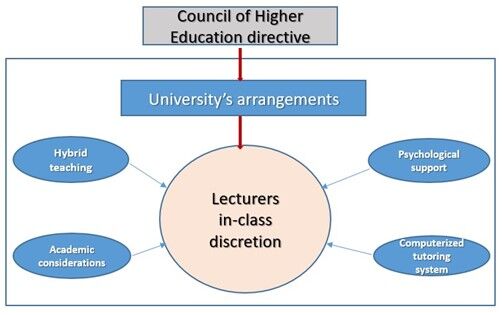
With the outbreak of the war and after roughly four weeks of postponing the 2023/2024 academic year, the Israeli Council for Higher Education published its decision not to cancel the entire Fall semester. Immediately and following the Council’s general directive, universities began designing their new arrangements for all university’s units, faculty, and students. As shown in Figure 1 below, the universities adjusted their arrangements to the Council’s directive, and following, the lecturers implemented the university’s guidelines, yet were still highly independent in managing their classrooms using their discretion.
Figure 1 – The war adjustments process
In the following sections, I draw on (1) what the university as an institution can do in a conflictual reality, that is beyond the classroom, and (2) what each lecturer can do. This is based upon my experience teaching at the Lauder School of Government, Diplomacy & Strategy at Reichman University in Israel during the conflict that broke out on October 7, 2023.
(1) Institutional adjustments
With the nationwide decision not to annul the first semester due to the war, the university was committed to facilitating a smooth integration into the academic year. The adjustments created at the university level make the general all-embracing framework. It touched on all the university’s units and systems, faculty and varied populations of students, namely: international students, local students and reserve-duty students. Adjustments to the latter were gradual (linked to the time they are back from reserve-duty) and most significant. Three points were most serious in the university’s adjustments: academic adjustments, reserve-duty student’s special arrangements and psychological aid.
Academically, the university determined new and clear academic criteria that include the university’s policy on teaching arrangements (e.g., moving to hybrid teaching, grade structure, number of classes, reduction in assignments, altering class exams to take-home exams/final assignments, academic support for reserve duty students, providing advice for lecturers on how to manage the classroom and psychological support for students). This was to be implemented at once.
Adjustments made for reserve-duty students were a critical component in the overall plan. These adjustments were made for students who did not commence the semester with their fellow students. The university has highlighted that it will do everything in its power to support them to the fullest extent possible. Practically, within several weeks, a comprehensive program was set up, including: assigning advisors to each school, who are available to assist reservists; encompassing video recordings of all on-campus lectures; offering extended lecturer’s office hours; and increasing the number of courses eligible for a binary pass/fail grade (the directive of the Council for Higher Education stipulates a maximum of 3 courses). It was also decided to grant extra time for exams for reservists.
The psychological aspect was also a core pillar point in the university’s arrangements. It was clearly communicated that every student is entitled to contact the counseling services for support and/or psychological treatment, with a focus on returning to school after a reserve-duty period, adapting to an emergency routine, and dealing with the lose of friends and loved ones, as well as on issues related to studies/work/residence/relationships/health/addiction and more. Further, the student’s government in cooperation with the Center for Learning Skills have created a joint physical learning space so that students can sit and study together, combining it with workshops on ‘relaxation and learning skills in a complex reality.’ Lecturers were also noted to mention these services to students they believe are in distress.
Though making a clear overall framework for lecturers, the latter were able to do much to make this challenging academic year work out. Here are several of my own impressions.
(2) Classroom pedagogical adjustments
Obviously, due to war-related tensions the classroom is even less homogeneous than before as students are not mentally as free as before for learning. Many of them experience emotions that consume mental energy that impair the ability to pay attention in class. Further, they face many security-related anxieties, feelings of guilt about “moving on” in life and in their studies while their reserve-duty friends did not, difficulty imagining a future, and fatigue from dealing with bereavement and pain. Based on the university’s suggestions for best practices combined with my hands-on experience, I would like to offer some pedagogical adjustments for lecturers.
First, we must be highly patient towards students as we are not always clear on what is behind their behaviors/attitudes. Some know how to ask for our assistance, yet others might not. Students in my courses demonstrated different degrees of adjustments to the stressful situation, which at times challenged my judgement towards exaggerated requests for academic consideration (e.g., submission dates, attendance and more). I suggest meeting every request from an inclusive place, along with clarifying the rules and maintaining boundaries. Clarity, order and transparency are (always!) of great importance. At the same time, this calls for flexibility, namely, offering alternatives to fulfill the course obligations.
Second, much can be done to assist students in a classroom that includes hybrid teaching, while still creating a sense of normality. Specifically, during the war many international students at Reichman University have traveled back home, making hybrid teaching—as taught during COVID-19—a necessity. This has caused the class to include different groups with different mind-sets; an online group at their homes and an in-class group. Further, mentally some of them wanted to detach themselves from the difficulties that war has imposed upon them and concentrate in learning, while others were unable to detach, feeling anxious and struggling to maintain concentration. My experience has taught me that the best practice is simply constructing pedagogically diverse and highly interesting classes that touch on other case studies world-wide.
Practically, I have used international current affairs to exemplify the theory taught and demonstrated it using YouTube videos. I have also had students implement the material taught through group class assignments via Padlet. The activity took place at the same time in break-out rooms on Zoom, and was supervised by the TA. This way I was able to teach, while distracting the students from the conflictual reality and not leaving the Zoom group out of the loop. Realizing this will also assist lecturers not to be disappointed when their plan for a straightforward traditional class does not go as expected.
Third, the student’s learning curve might change during irregular circumstances. This, from my viewpoint, has occurred both during the pandemic and during war. Realizing this, lecturers should try not to ‘speed up’ to meet their syllabi’s goals, since the process of learning during a time of crisis is slower due to mental/emotional load that jeopardizes one’s concentration and attention. Again, to make the class as normal as before, we must disconnect the lesson from the news, and create a safe space for learning. Naturally, if an alarm goes off during class, this will be hard to do, yet if the class goes as scheduled, some academic vacuum can be beneficial to all parties involved. This at times did motivate the students and speeded up the learning pace in my classes.
Finally, and in my view always applicable, we must pay attention to the political sensitivities of different groups in class. If (but only if) a conflict breaks out in class, we should acknowledge the explosiveness of the situation, but not allow offensive discourse to take over the subject of the lesson. As my teaching experience at Reichman University has taught me in the past decade, teaching politics to students from 94 countries around the globe, political dispute is always just “around the corner,” and we should be prepared to handle it the best possible way. For example, when discussing the Russia-Ukraine war, or characterizing the Russian regime in a comparative politics class, with the presence of students from both states, lecturers must take on a highly professional approach, emphasizing the theoretical framework of analysis, rather than focusing on the conflict’s sensitive lines. They should also use multiple case studies during the course and not focus on any one or a few, so no one feels “targeted.”
Overall, the key takeaways that were offered here illustrate a professional cooperation between the university and its lecturers. Indeed, allowing the latter a discretional domain to implement the institutional policy (along with the material resources to do so) is critical for overall institutional success and the well-being of the students. Best practices-wise, lessons from the pandemic era assisted universities to adjust much more quickly to the new challenges war has imposed on it, despite not being completely identical in nature. This means that we must document and improve our knowledge of academic teaching at irregular times.
References
Brennan, Jonathan. 2020. Engaging Learners through Zoom: Strategies for Virtual Teaching across Disciplines. Hoboken, NJ: John Wiley & Sons.
Kostikova, Ilona, Liudmyla Holubnycha, Oleksandra Marmaza, Viktoriia Budianska, Olha Pochuieva, and Halyna Marykivska. 2023. “Real Country Experiences: On-line Teaching in Wartime after Pandemic in Ukraine.” https://doi.org/10.3991/ijim.v17i03.36419
Lavrysh, Yuliana, Iryna Lytovchenko, Valentyna Lukianenko, and Tetiana Golub. 2022. “Teaching During the Wartime: Experience from Ukraine.” Educational Philosophy and Theory: 1-8.
Mahoney, James. 2000. “Path Dependence in Historical Sociology.” Theory and Society 29(4): 507-548.
Pierson, Paul. 2000. “Increasing Returns, Path Dependence and the Study of Politics.” The American Political Science Review 94(2): 251-267.
Stafford, Vanessa. 2020. “EdTech review: Teaching through Zoom–What We’ve Learned as New Online Educators.” Journal of Applied Learning and Teaching 3(2): 150-153.
Stefanile, Adam. 2020. “The Transition from Classroom to Zoom and How it Has Changed Education.” Journal of Social Science Research 16: 33-40.
Sytnykova, Yu, Maryna Shlenova, Ye Kyrpenko, Vitalii Kyrpenko, Nataliia Konoplenko, and Ihor Hrynchenko. 2023. “Teaching Technologies Online: Changes of Experience in Wartime in Ukraine.” https://dspace.hnpu.edu.ua/handle/123456789/13308
—
Niva Golan-Nadir is a Research Associate at the Center for Policy Research, Rockefeller College of Public Affairs & Policy at the University at Albany, SUNY, and at the Institute for Liberty and Responsibility, Lauder School of Government, Diplomacy & Strategy at Reichman University, where she heads the honors program. She further teaches Comparative Politics and Research Methods at the Raphael Recanati International School.
Published since 2005, The Political Science Educator is the newsletter of the Political Science Education Section of the American Political Science Association. All issues of The Political Science Educator can be viewed here.
Editors: Colin Brown (Northeastern University), Matt Evans (Northwest Arkansas Community College)
Submissions: editor.PSE.newsletter@gmail.com
As part of APSA’s mission to support political science education across the discipline, APSA Educate has republished The Political Science Educator since 2021. Please visit APSA Educate’s Political Science Educator digital collection here.