Political Science Educator: volume 28, issue 1
Reflections
By Dale Mineshima-Lowe (d.mineshima-lowe@parami.edu.mm)
I’ve spent the past two plus years teaching synchronous online classes twice a week to undergraduate students in Myanmar (Burma). As a visiting faculty member, I have seen to-date, high levels of student engagement in their learning within this online classroom environment. However, in the Spring 2024 semester, I will admit it became more challenging to hold students to course expectations and requirements as strictly as one would like, while recognizing how their everyday experiences were evolving, physically and emotionally, with the inception of conscription laws for the military and the limitations on their electricity supply. These barriers impacted, at times, their access to their learning, but not their enthusiasm and drive to learn. The students have revealed their resilience and their determination to learn, so that they can one day apply the skills and knowledge they gained from their studies to be future change-makers. As the semester ended, I found myself reflecting on this more recent experience and reconsidering the practices of online learning. I thought about how I continually adapted my teaching to support their learning in a changing political landscape. What follows is what I learned, which is applicable to teaching online or in person.
Background of the Conflict
Since February 2021, when power was seized from the democratically-elected government under Aung San Suu Kyi, Myanmar has been under a military government. Over the past three years, there has been a series of restrictions that have impacted the daily lives of the people within the country. There have been restrictions on the media–in terms of who is able to broadcast and what can be broadcast as “news,” the restrictions on and banning of certain journalists, as well as new taxation measure on internet services and even the purchase of SIM cards– all ways to control information flow and communications (Reporters Without Borders 2024). Additional restrictions in the form of electricity and power cuts have been occurring more regularly since 2019 and has increased since 2021, from disruptions due to the ongoing conflict between the military government and opposition and other ethnic groups. Myanmar’s heavy reliance on hydropower (up to around 75% of its electricity output) and the reliance on rainy periods for this, has had an impact on capacity and differentiated availability of electricity across the country. Students have also been impacted by the military government’s recent public notification to enforce the 2010 Myanmar’s People Military Service Law which mandates conscription into the military service for two-years, of all men aged 18–35, and all women aged 18-27. Public notification came out in February 2024 to take effect in April 2024 (Ratcliff and Soe 2024), causing a ripple effect with many younger Burmese citizens and their families looking for ways to assist in their exit of the country before being “called” for military service.
Some Key Lessons in Meeting Student Needs
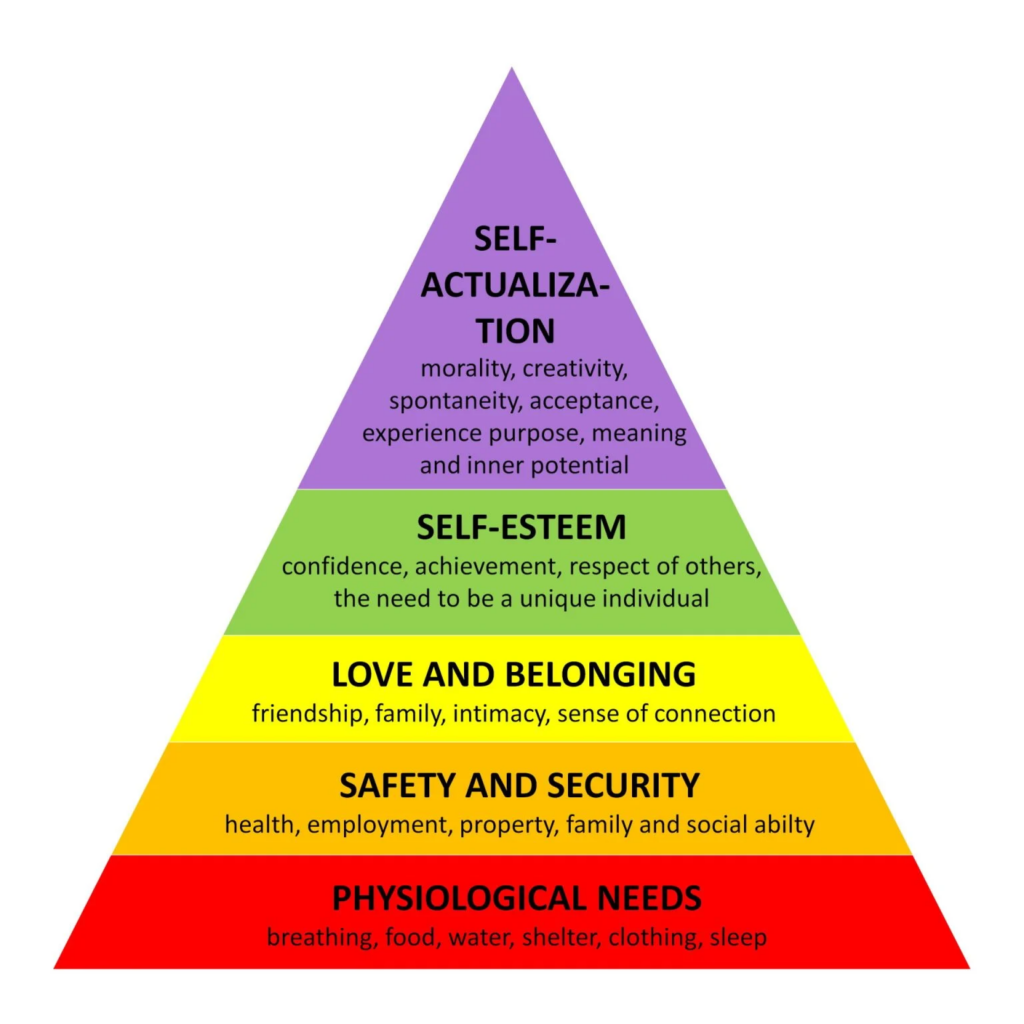
Some of my key take-aways from the past semester have been around providing a clear structure for learning that considers students’ needs. Here I borrowed ideas from (Milheim 2012) and her discussion about applying Maslow’s “Hierarchy of Needs” (1943) to the online learning environment. These include considering the different levels of needs (like physiological needs, safety and security, belonging, self-esteem, and self-actualization). Below I explain how I helped meet these needs for students as lessons that can be brought into other teaching contexts.
BELONGING: Create and foster a learning community by building rapport between teachers and students, and between students (Glazier 2021) that goes beyond the topics studied and allows students to connect to each other. While we were using Zoom and Canvas learning management system (LMS) for class sessions, I started with a pre-course task that asked students to introduce themselves and what they hoped to gain from the course. This was shared with me directly in response to my own sharing about myself and why I was interested in teaching our course this semester. To develop our learning community throughout the course, we used a combination of the LMS, Zoom breakout rooms, the Workplace app, Telegram, discussion forums, and Padlet boards (started in-class and then flipped to continue work asynchronously but linked between students). Sometimes we used something as simple as a Google doc to annotate an excerpt of a reading–something that could be started together in-class and then carried over to asynchronous work, provided valuable shared learning spaces to comment on readings, others’ comments, add links to other information and resources among the group. This led to students sharing resources they came across in their independent research and reading, as well as other non-course related things like opportunities for future studying in and outside of Myanmar, and about the availability of financial support for their studies.
BELONGING: Include space to create “reflexivity” in students (Kahn et al 2017). Here, I set out in the syllabus our weekly topics and schedule, but within each class session, I created in-class individual and small group tasks (e.g., key concepts from readings, mini research tasks, and presentations) that scaffolded introduction to new concepts and skills and provided students with opportunities to use these within an active, student-centred learning environment (Mulcare and Shwedel 2017). The tasks allowed students to work within different groupings online, which in turn developed a learning community that went beyond our classroom time.
Figure 1 – Maslow’s Hierarchy of Needs, from Mcleod (2024)
PSYCHOLOGICAL NEEDS, SAFETY, and SECURITY: Keep as informed as you can about the changing situation in the country. This is not something that is always easy to do. For myself, I tried to stay informed about the changes occurring within Myanmar through reports from some international news outlets like the BBC (although coverage has been limited), any recent UN agency reports, and news sites like The Irrawaddy[1] (created by Myanmar journalists in exile in Thailand), Myanmar Now[2], and Reporters Without Borders[3]. I’ve searched for additional updates from websites, reports, and social media posts by NGOs and other civic organization within the region. For up-to-date news, this has come from other faculty, support staff, and students who themselves are still in Myanmar, and were willing to share some of what they are seeing, hearing about, and experiencing.
SAFETY, SECURITY, SELF ESTEEM: Understand the diversity of circumstances of students in the classroom (Cannell and Voce 2023) and remain flexible with classroom sessions. Most if not all students are willing to let you know the practicalities and what their limitations are today (e.g., weak internet connection, lack of electricity to run their laptops, using cell phone data to connect, trouble moving into breakout rooms, packing to move to another area or town, etc.). Knowing these details was helpful to understanding changing levels of engagement within my class over the semester.
SELF-ACTUALIZATION: Remain flexible towards adjusting class content and activities and have alternate plans that can be implemented as needed. For instance, I ended up adjusting our class sessions to provide additional guidance and “create” time within class sessions to scaffold some of the work to be completed for assessment policy briefs students were creating. This included ‘tasks’ that students undertook in pairs or small groups to “test” ideas, contextualizing topics to their experiences, and working through possible solutions (Man-Ho Lam 2024) by presenting these on our class Padlet board. Eventually working our way to practice runs of our final projects, and then to students presenting to the class their final project policy briefs, asking questions about their peers’ work and providing constructive feedback.
While the ideas listed here are by no means new, the three inter-related things that struck me most were about fostering trust, managing the struggles that accompany conflict, and becoming aware of my own limitations as a remotely located faculty. On the question of trust, how can you foster trust among and within the class group where learning is taking place within a place where conflict is happening? To me, this meant finding a way for students to share with me what brought them to the course and finding a way to reciprocate so that the trust was not unidirectional. In terms of managing the struggles that accompany conflicts as they have real impact on learning, I found creating additional access points for students to participate and actively engage with their learning together made the course accessible no matter what the student circumstances were in terms of electricity, internet connectivity, physical space for learning, and in the event of relocation part way through the course. These different access points include simple online post-it notes, polling, dropping a short blog note, and socially annotating an excerpt from our reading together or asynchronously. Finally, in terms of my own limitations, I had to recognize that in a world where more students are struggling for their learning, looking for how I could do small things to create a learning environment that supports them as best I could within my limited resources proved worthwhile to the students I had the great fortune to work with.
Endnotes
[3] https://rsf.org/en/country/Myanmar
References
Cannell, Pete and Julie Voce. 2023. “The Student Voice” in Linda Amrane-Cooper, David Baume, Stephen Brown, Sarah Hatzipanagos, Philip Powell, Sarah Sherman, and Alan Tait (Eds.) Online and Distance Education for a Connected World. UCL Press.
Glazier, Rebecca A. 2021. Connecting in the online classroom: Building rapport between teachers and students. Johns Hopkins University Press.
Kahn, Peter, Lucy Everington, Kathleen Kelm, Iain Reid, and Francine Watkins. 2017. “Understanding student engagement in online learning environments: the role of reflexivity.” Educational Technology Research and Development, 65(1): 203-218. https://doi.org/10.1007/s11423-016K-9484-z
Man-Ho Lam, Adrian. May 6, 2024. “Using experiential learning to teach international relations.” Times Higher Education. https://www.timeshighereducation.com/campus/using-experiential-learning-teach-international-relations
Mcleod, Sarah. 2024. “Maslow’s Hierarchy of Needs.” Simply Psychology [web site]. https://www.simplypsychology.org/maslow.html
Milheim, Karen L. 2012. “Towards a better experience: Examining student needs in the online classroom through Maslow’s hierarchy of needs model.” Journal of online learning and teaching 8(2): 159-171.
Mulcare, Daniel M. and Allan Shwedel. 2017. “Transforming Bloom’s Taxonomy into Classroom Practice: A Practical Yet Comprehensive Approach to Promote Critical Reading and Student Participation.” Journal of Political Science Education 13(2): 121-137. https://doi.org/10.1080/15512169.2016.1211017
Ratcliffe, Rebecca and Aung Naing Soe. February 28, 2024. “’They have lists of everyone’s names’: Myanmar conscription law unleashes wave of fear.” The Guardian.
Reporters Without Borders. 2024. “Myanmar.” https://rsf.org/en/country/Myanmar
—
Dale Mineshima-Lowe is currently an Academic Co-Director of Environmental Education Projects and Associate Lecturer in the School of Social Sciences at Birkbeck, University of London. She has also been a Visiting Faculty member at Parami University (USA/Myanmar) since 2022.
Published since 2005, The Political Science Educator is the newsletter of the Political Science Education Section of the American Political Science Association. All issues of The Political Science Educator can be viewed here.
Editors: Colin Brown (Northeastern University), Matt Evans (Northwest Arkansas Community College)
Submissions: editor.PSE.newsletter@gmail.com
As part of APSA’s mission to support political science education across the discipline, APSA Educate has republished The Political Science Educator since 2021. Please visit APSA Educate’s Political Science Educator digital collection here.