August 13, 2024 | Respectful political dialogue between engaged citizens is a cornerstone characteristic of a healthy democracy. How can faculty establish a classroom culture encouraging constructive and inclusive political discussion around the 2024 U.S. election and other common political science themes? How can political science educators scaffold productive civic dialogue on contentious political issues?…
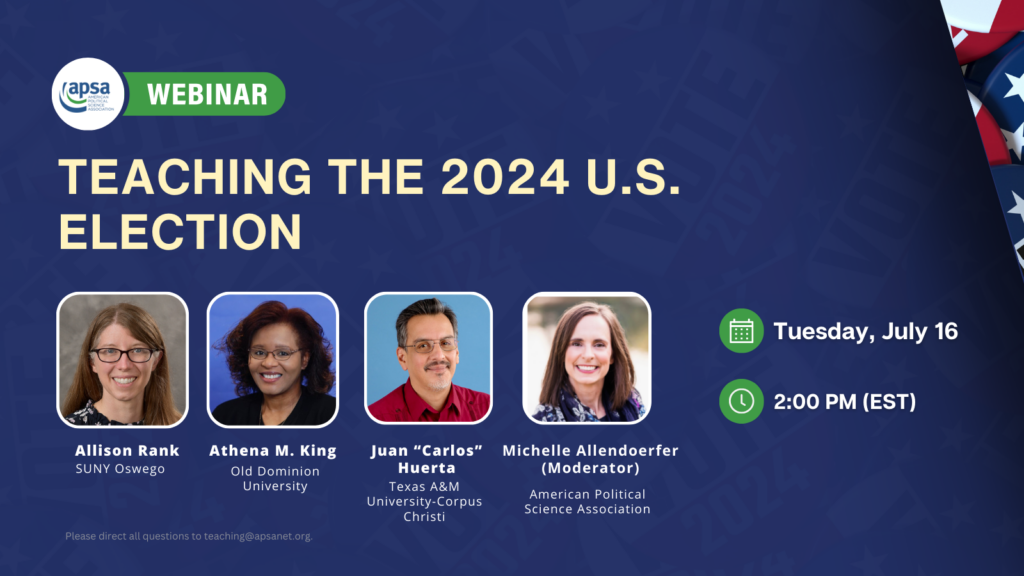
July 16, 2024 | How are political science educators bringing the 2024 U.S. election into their classrooms? What assignments or activities should political science educators use to help undergraduates understand the 2024 U.S. election? What tools can faculty use to address campaign and election mis- and disinformation? Please watch the webinar recording above and check…
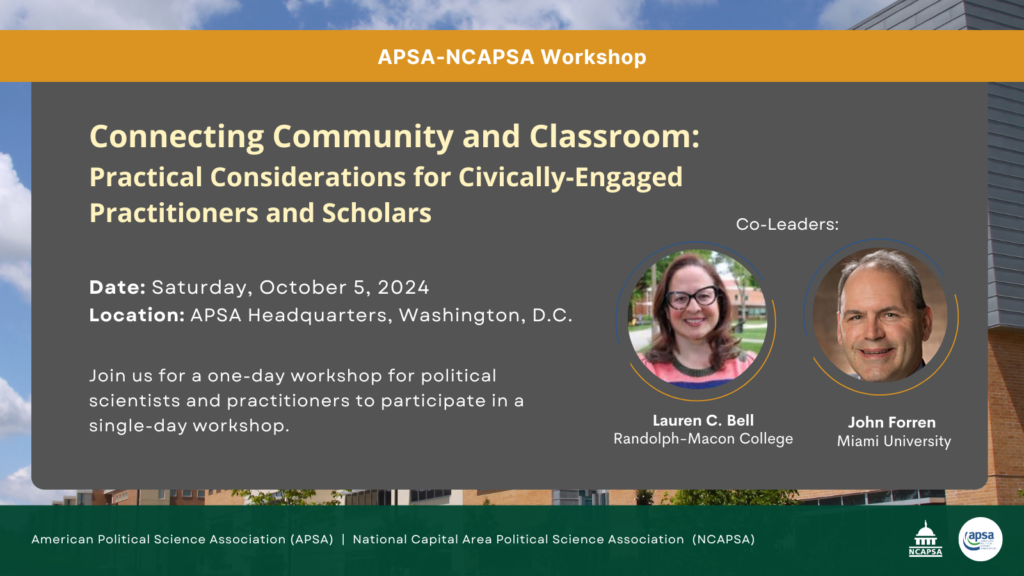
October 5, 2024 | Register Here | View Program Schedule The American Political Science Association (APSA) and The National Capital Area Political Science Association (NCAPSA) are thrilled to invite political scientists and practitioners to a single-day workshop, Connecting Community and Classroom: Practical Considerations for Civically-Engaged Practitioners and Scholars, on Saturday, October 5, 2024, at APSA’s…
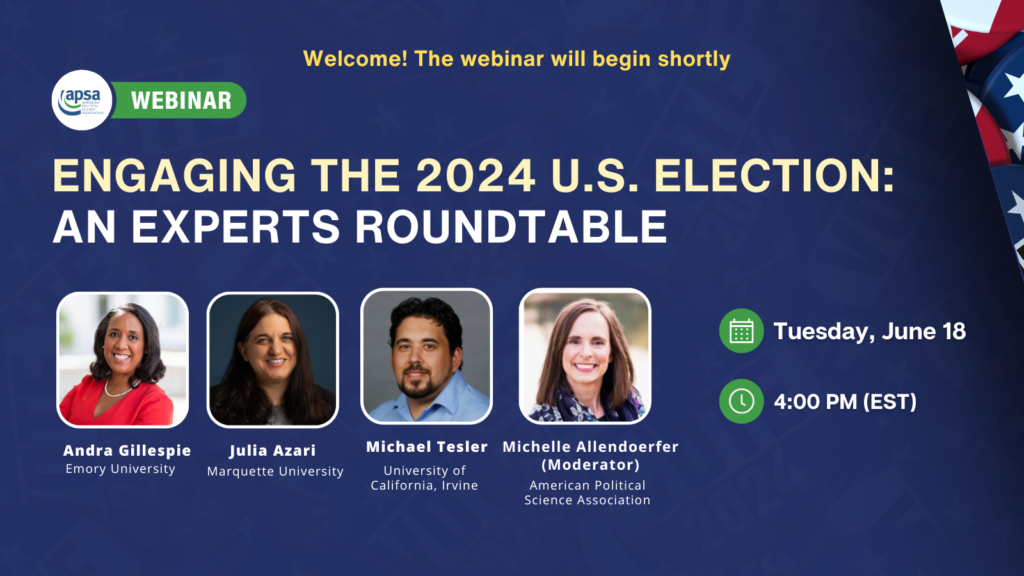
June 18, 2024 | How should we interpret the 2024 U.S. election? What are the key factors driving the national campaigns? What is at stake in this election? Check out the recording above to learn how three political scientists understand the upcoming presidential and congressional elections. Engaging the 2024 U.S. Election Webinar Series This webinar…

Political Science Educator: volume 28, issue 1 As another spring semester comes to close, I want to reflect on our accomplishments and our future as a section. Work on updating the mission statement for the section is ongoing. I am proud to announce that two candidates proposed by the section will be on the ballot…
Political Science Educator: volume 28, issue 1 Member Announcements Lauren Bell, Allison Rank, and Carah Ong Whaley will publish an edited volume in July 2024, Civic Pedagogies: Teaching Civic Engagement in an era of Divisive Politics with Palgrave Macmillan. Several PSE section members contributed chapters, and the authors “offer innovative pedagogies and praxis grounded in…
Political Science Educator: volume 28, issue 1 Reflections By Erik Ringmar (erik@ringmar.net) When ChatGPT-3.5 was released on the world in the fall of 2022, there was a collective sense of amazement. This was not a ghost in a machine, but instead something suspiciously close to a human being. The chatbot engaged in conversations on any…
Political Science Educator: volume 28, issue 1 Reflections By Janet L. Donavan (janet.donavan@colorado.edu) As a political scientist who regularly teaches Introduction to American Politics and Media and Politics, helping students develop information literacy is a key learning goal in my teaching. An important topic in these courses is learning how data is utilized to tailor…
Political Science Educator: volume 28, issue 1 Reflections By Justin Robertson (justin.robertson@cityu.edu.hk) The arrival of ChatGPT has sparked existential questions about the future of the humanities and social sciences and has been accompanied in its wake by a hardline response: some instructors treat any use of ChatGPT as a punishable form of plagiarism. The following…
Political Science Educator: volume 28, issue 1 Reflections By Colin M. Brown (colin.brown@northeastern.edu) I came out of an undergraduate and graduate tradition of assigning massive reading lists on each course syllabus. While I often did not read everything assigned (sorry!), I remember spending a considerable amount of time reading outside of class. It took a…