Political Science Educator: Volume 30, Issue 1
Reflections
By Doina Cuciurca (cuciurcadoina@gmail.com), Judithanne Scourfield McLauchlan (jsm2@usf.edu), Lia Butucel (lia82butucel@gmail.com)
For more than thirty years, scholars have studied the use of technology to connect students from around the world in order to create “global classrooms” (Kurshan 1991). Faculty have continued to experiment with new technology and new social media platforms to connect students with classmates overseas. For example, Zeiser, Fuchs, and Engelkamps’s “discussions across borders” used online discussions to connect students in Florida and Germany. Higgins, Wolf, and Torres employed social learning platform ValuePulse to connect marketing students in California and Ireland. Shaw’s use of Facebook to engage students cross-nationally in discussion board posts, to name a few.
Simultaneously universities emphasized the importance of internationalizing the curriculum as a part of strategic planning efforts to develop “global citizens” (Shaw 2016; Lamy 2007). For example, the AAC&U website shares best practices for defining “global learning” as well as an explanation as to why diversity and global learning is a high impact practice.[1] Leask (2009) defines internationalizing the curriculum as “a curriculum that purposefully develops the international and intercultural perspectives (skills, knowledge, attitude) of all students.”
With these concepts in mind (developing the skills, knowledge and attitude of global citizens), we developed a collaborative comparative constitutional law assignment that linked students at the University of South Florida St. Petersburg (USFSP) and Moldova State University (USM). What began as an international teaching partnership developed into a meaningful learning experience that combined comparative legal analysis, intercultural communication, and sustained student collaboration.
The premise was simple: Students often understand comparative constitutional law more deeply when they engage directly with peers who study and experience another constitutional system from within. Rather than learning about another legal order only through readings or lectures, students had the opportunity to discuss it with one another, compare assumptions, and work together on shared academic tasks.
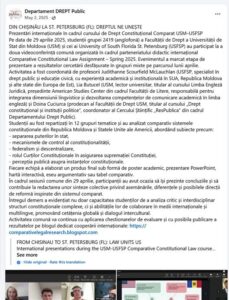
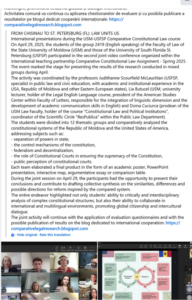
Previously we collaborated on full-semester (10-to-12-week projects) and one-time collaborations (such as Constitution Day events). For this project, we designed a mid-range assignment that engaged the students for a shorter portion of the semester. During a six-week period, students from the two universities worked in mixed international teams and explored a range of constitutional topics from both U.S. and Moldovan perspectives. These included separation of powers, constitutional review, role of constitutional courts, federalism and decentralization, and public perceptions of constitutional justice. The project concluded with a joint online conference during where student groups presented their findings and reflected on similarities, differences, and lessons drawn from the comparisons. This structure and sequence built directly on the project description and objectives reflected in the draft materials prepared from the original USM communication about the event.[2]
One reason the project worked so well was its format. It was not limited to a single international joint class meeting, but also it did not require a full-semester exchange. Instead, it occupied a productive middle ground: long enough for students to build working relationships and complete meaningful joint work, yet short enough to remain manageable within existing course structures. In our experience, this “middle model” is especially useful for instructors who want to internationalize a course without redesigning the entire semester.
The final work products varied by group. Students created PowerPoint presentations, comparative tables, argumentative texts, research posters, and/or other visual materials. More important than the format of the final products, however, was the fact that the work was genuinely collaborative. Students were not simply presenting their own national systems side by side. They were expected to work together, compare interpretations, divide responsibilities, and produce a shared result.
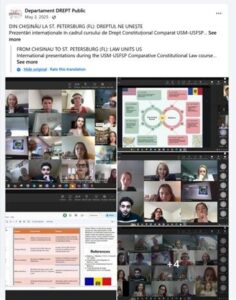
From an intercultural perspective, this was one of the project’s greatest strengths. Not merely exposed to a different academic and legal culture, students experienced them by communicating across differences to complete a common task. That required clarity, patience, flexibility, and mutual respect. One participant described the first Zoom meeting as “awesome” and recalled leaving it “genuinely excited about this project,” which captures the tone of openness that helped the collaboration take root from the beginning.[3]
Language played a central role in the project. For Moldovan students, English functioned as a genuine academic working language rather than merely a classroom exercise. The USM students actively used English to discuss constitutional concepts, articulate legal reasoning, and apply domain-specific legal terminology with increasing precision while engaging in international teamwork with their American partners. For the U.S. students, the experience fostered more intentional communication and heightened awareness of how academic discourse operates in multilingual settings, particularly in relation to clarity, terminology, and conceptual alignment. Consequently, language became integral to the learning process rather than secondary to the legal content.
The project also encouraged students to think comparatively in a more active way. Instead of learning only the basic institutional features of another constitutional system, students asked why those structures developed differently, how legal ideas are shaped by political and historical context, and what assumptions they themselves brought into the conversation. Those questions made comparisons more dynamic and more reflective.
The student reflections also show that the interpersonal dimension mattered. One student wrote that it was “cool seeing how students from different countries think about law and government so differently,” while also noting that the group found “a surprising amount of common ground.” Another described the collaboration as “way more collaborative and fun than I expected.”
These student reactions point to a valuable outcome of short-term international projects: They can reduce distance quickly and replace uncertainty with curiosity, familiarity, and mutual engagement.
We also saw broader benefits. Students strengthened teamwork skills, learned to coordinate across distance and schedule differences, and practiced presenting complex legal ideas in a clear and accessible way. Just as importantly, they experienced what many institutions now describe as global learning: the ability to engage thoughtfully and respectfully with people shaped by different educational, historical, and civic contexts.
That learning via Virtual Global Exchange (VGE) did not come without challenges. Students navigated a seven-hour time difference, busy schedules, family obligations, and difficulty of finding common meeting times. One group addressed this by shifting much of their collaboration to WhatsApp so that members could contribute asynchronously.
Another participant recalled the intensity of “crunch time,” but added that “somehow it was kind of fun,” a detail that speaks to the positive team dynamic built during the project. For Moldovan students, the collaboration provided an important opportunity to participate in English-language academic exchange and to present legal analysis to an international audience. For U.S. students, it offered direct exposure to a different constitutional culture and a more grounded understanding of comparative public law. For both groups, the project made abstract ideas more concrete by linking doctrine, institutions, and lived academic dialogue. One student summarized this especially well, writing that the exchange led to “a deeper understanding” of how constitutional mechanisms differ across systems, while another expressed the experience even more simply: “10/10 would work with international students again.”
Lessons learned that we hope will be helpful to faculty who seek to internationalize their courses with a Virtual Global Exchange component:
- First, shared learning goals are essential. International collaboration works best when it grows naturally out of course objectives. In our case, the comparative structure of the course made the partnership feel substantive rather than supplementary.
- Second, clear structure matters. Students need defined topics, realistic timelines, and specific outputs. Mixed teams and concrete deliverables helped create accountability and kept the collaboration moving forward.
- Third, keep the technology We did not need elaborate infrastructure. Video conferencing (via MS Teams), shared files (in Box or Google Drive), and straightforward communication channels (email, WhatsApp, Facebook messenger) were sufficient because the academic design and Student Learning Outcomes were clear.
- Fourth, flexibility is important. Time zones, institutional schedules/calendars, and different academic rhythms can easily create friction. A combination of synchronous interaction and asynchronous teamwork made it easier for students to stay engaged without making the project overly difficult to manage.
- Fifth, instructors should not assume that meaningful global collaboration requires a full semester, travel funding, or a large institutional initiative. One of the clearest lessons from this experience is that a carefully designed project of intermediate length can still produce substantial academic and intercultural benefits.
This project does not replace longer-term exchange programs or more formal research collaborations. It does, however, offer a practical model for faculty who want to introduce international comparative learning into an existing course in a manageable way. In our case, students gained more than content knowledge. They practiced working across difference, developed confidence in international academic communication, and experienced constitutional comparison as a living conversation rather than a purely textual exercise.
For us, that is what made the project successful. It expanded the classroom without making the teaching model unrealistic. It asked students to think comparatively, communicate intentionally, and collaborate across borders. And it did so in a format that we believe other instructors can adapt for their own courses.
Acknowledgements
The authors gratefully acknowledge the support of faculty development initiatives that encourage virtual global exchange and international collaborative teaching. These efforts helped create the conditions for this project and for the broader conversations it made possible. Dr. McLauchlan thanks especially USF World and the 2024-25 Virtual Global Exchange Faculty Learning Community at the University of South Florida.[i]
References
Barber, Benjamin R. 2007. “Internationalizing the Undergraduate Curriculum, Opening Commentary.” PS: Political Science and Politics 40(1): 105.
Brunell, L. A. 2013. “Building Global Citizenship: Engaging Global Issues, Practicing Civic Skills.” Journal of Political Science Education, 9(1): 1633.
Kurshan, Barbara. 1991. “Creating the Global Classroom for the 21st Century.” Educational Technology. 31(4): 47-50
Lamy, Steven. 2007. “Challenging Hegemonic Paradigms and Practices: Critical Thinking and Active Learning Strategies for International Relations.” PS: Political Science and Politics 40(1): 112-116.
Leask, Betty. 2009. “Using Formal and Informal Curricula to Improve Interactions between Home and International Students.” Journal of Studies in International Education. 13(2): 205-221
Higgins, Lindsey; McGarry Wolf, Marianne, and Torres, Anne T. 2013. “Opening the Doors to a Global Classroom: An International Social Media Collaboration.” NACTA Journal 57(3a): 40-44.
Martin, Pamela L. 2007. “Global Videoconferencing as a Tool for Internationalizing Our Classrooms.” PS: Political Science and Politics 40(1): 116-117.
McLauchlan, Judithanne. 2024. “Creating a Global Classroom: International Collaborative Legal Research Partnerships.” Journal of Legal and Political Education 1(1): 1-17. https://e-jlia.com/index.php/jlpe/article/view/1487
McLauchlan, Judithanne and Jusuf Zejneli. 2020. “Creating a Global Classroom: Developing Collaborative Legal Research Partnerships for Undergraduate Students in the U.S. and North Macedonia.” JUSTICIA: International Journal of Legal Sciences 8(13).
McLauchlan, Judithanne, Karla Morris, and Steph James. 2020.“Simulations in Online Courses: Integrating Synchronous Experiential Learning Opportunities for Students in the Virtual Classroom” The Teaching Professor.
McLauchlan, Judithanne and Larisa Patlis. 2015. “Cultivating Global Citizenship in Higher Education: Civic Engagement and Service Learning in Joint Study Abroad Courses.” Revista Internacional de Educacion para la Justicia Social (RIEJS) 4(1): 111-129.
McLauchlan, Judithanne and Svetlana Suveica. 2012. “Creating a Global Classroom: Providing Collaborative Research Opportunities for U.S. and Moldovan Students.” Journal for Civic Commitment 19.
Shaw, C.M. 2016. “Connecting Students Cross-Nationally Through Facebook.” Journal of Political Science Education 12(3): 353–368.
Taras, Vas, et al. 2013. “A Global Classroom? Evaluating the Effectiveness of Global Virtual Collaboration as a Teaching Tool in Management Education.” Academy of Management Learning & Education 12(3): 414-35.
Zeiser, P. A., Fuchs, D., & Engelkamp, S. (2013). “Discussions Across Borders: A German-American Partnership.” Journal of Political Science Education 9(4): 474–486.
—
Judithanne Scourfield McLauchlan, Ph.D. is a public law scholar and civic education specialist at the University of South Florida St. Petersburg.
Doina Cuciurca, PhD. in Law is a University Lecturer and a researcher in the field of constitutional law at Moldova State University.
Lia Butucel, MA in Philology and Ph.D. candidate is a University Lecturer at Moldova State University. She teaches Legal English. Her work focuses on academic communication, intercultural learning, and international educational collaboration.
[1] https://www.aacu.org/trending-topics/high-impact
[2] Please email the Corresponding Author at jsm2@usf.edu for copies of relevant course assignment documents.
[3] Students were required to keep a journal documenting their cooperation with students from abroad as a part of the VGE assignment. In addition, we administered anonymous post-project surveys to the students via a googleform. Students at USF also completed the end-of-course evaluations (completed via a link sent to students’ university e-mail address.)
[i] https://www.usf.edu/world/global-learning/virtual-exchange/index.aspx
Published since 2005, The Political Science Educator is the newsletter of the Political Science Education Section of the American Political Science Association. As part of APSA’s mission to support political science education across the discipline, APSA Educate has republished The Political Science Educator since 2021. Please visit APSA Educate’s Political Science Educator digital collection.
Editor: Matt Evans (Northwest Arkansas Community College)
Assistant Editor: Colin Brown (Northeastern University)
Submissions: editor.PSE.newsletter@gmail.com
The views expressed in the posts and articles featured in the Political Science Educator are those of the authors and contributors alone and do not represent the views of APSA.