Political Science Educator: volume 29, issue 1 Reflections By Jack Santucci (jack.santucci@gmail.com) The Article Hunt (AH) is a tool for teaching students how to read academic articles quickly and research their own interests (Fisher and Frey 2014). It also can be used to cultivate scientific thinking (Bailey 2018; Schleutker 2022; Jeram 2024), scaffold literature reviews…
Political Science Educator: volume 29, issue 1 Reflections By Lila Hearn (hearnl1@unlv.nevada.edu) Modern political thought in the West cannot be understood apart from biblical tradition any more than it can be severed from the intellectual heritage of the Greeks. While scholars of teaching and learning have rightfully advocated for expanding political theory instruction beyond the…
Political Science Educator: volume 29, issue 1 Reflections By Cristina Juverdeanu (c.juverdeanu@qmul.ac.uk) I teach an advanced qualitative methods course and, as most modules of the kind, it focuses on key concerns one should be aware of when dealing with human participants: the principle of no harm, risk assessment, informed consent, confidentiality, and anonymity. These are…
Political Science Educator: volume 29, issue 1 Reflections By Titus Alexander (titusa03@gmail.com) Socrates taught in ancient Athens but never published anything. Yet we imitate him today, over 2,000 years later, because his student Plato and generations of teachers adopted his method of asking questions to guide inquiry. Any pattern of behavior that is replicated or…
Political Science Educator: volume 29, issue 1 The Teacher-Scholar By Elizabeth A. Bennion (ebennion@iu.edu) Generation Z makes up 20.7 percent of the US population. It is more racially and ethnically diverse than previous generations and on track to be the most educated.[i] Generation Z, along with the Millennials, are significantly different from older generations. Gen…
Political Science Educator: volume 29, issue 1 Reflections By Stefani Langehennig (stefani.langehennig@du.edu), Zach del Rosario (zdelrosario@olin.edu), Mine Dogucu (mdogucu@uci.edu) Introduction Despite their potential, Bayesian methods are rarely taught in undergraduate political science and public policy programs (Dogucu and Hu 2022). This gap stems from limited exposure among faculty, concerns about the subjectivity of priors (Fienberg…
Political Science Educator: volume 29, issue 1 Dear Colleagues, I hope this message finds everyone well as spring terms wrap up in the coming weeks. The Political Science Education Executive Committee has been busy with continuing and new initiatives this spring. As discussed at the Teaching and Learning Conference (TLC) and in the February newsletter,…

Political Science Educator: volume 29, issue 1 Back Matter Archived issues of The Political Science Educator through Vol. 27 can be found online at https://web.apsanet.org/teachingcivicengagement/political-science-educator/. Archived issues beginning with Vol. 26 are available at APSA Educate. Submissions: Please send any article submissions or announcements for future newsletters to the editors at editor.pse.newsletter@gmail.com. Please include “PS…
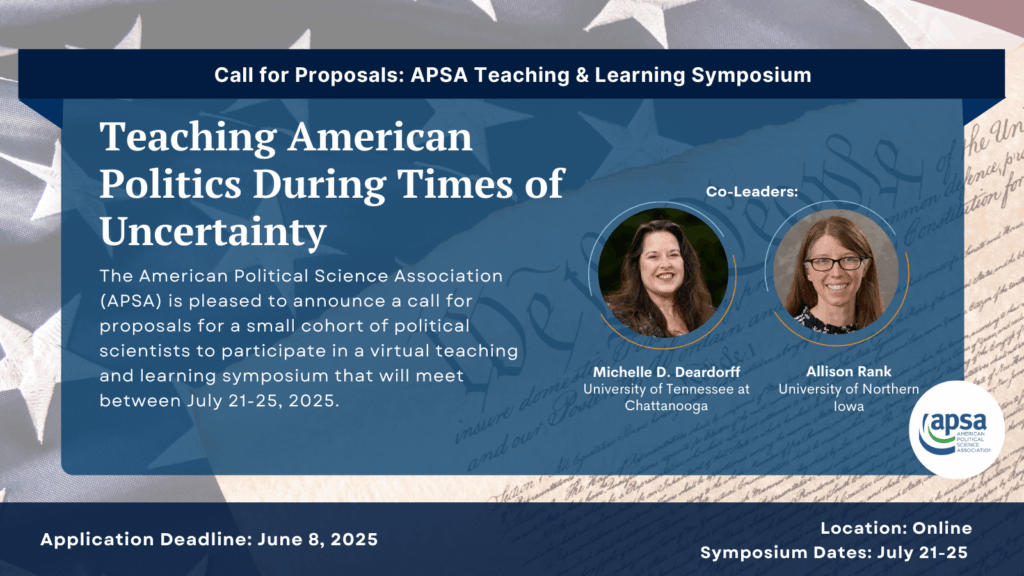
Call for proposals | APSA Virtual Teaching & Learning Symposium | Application Deadline: June 8, 2025 The American Political Science Association’s (APSA) Teaching and Learning Program is pleased to announce a call for proposals for a small cohort of political scientists to participate in a virtual teaching and learning symposium that will meet on Zoom…
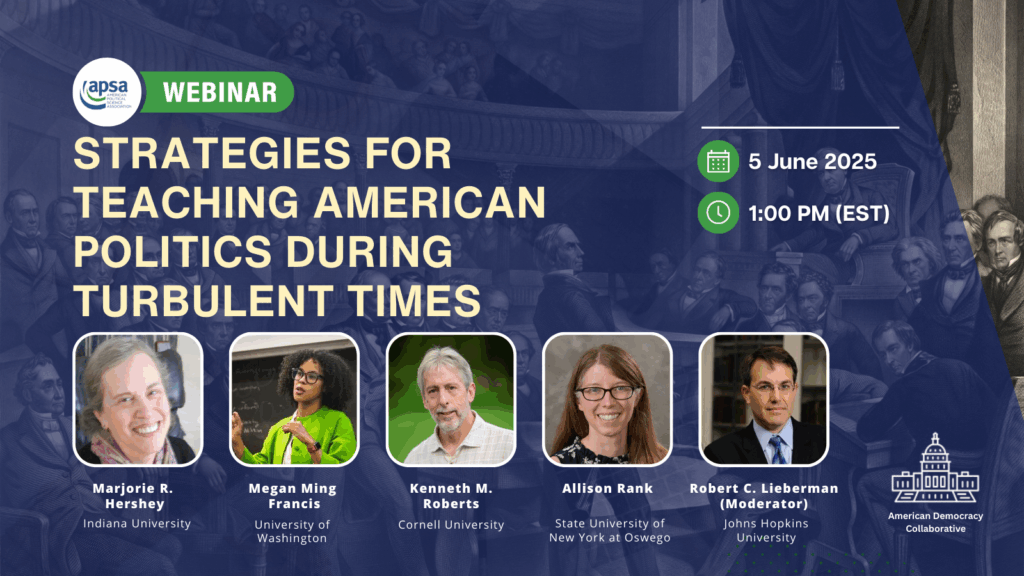
1 p.m. Eastern, Thursday, June 5, 2025 | Register Here Join our expert panelists for a discussion on teaching American Politics in times of political uncertainty and crisis. Responding to the current political environment in the United States, the panelists will share how they are rethinking the Introduction to American Politics class. Panelists will address…