Political Science Educator: volume 29, issue 1
Reflections
By Stefani Langehennig (stefani.langehennig@du.edu), Zach del Rosario (zdelrosario@olin.edu), Mine Dogucu (mdogucu@uci.edu)
Introduction
Despite their potential, Bayesian methods are rarely taught in undergraduate political science and public policy programs (Dogucu and Hu 2022). This gap stems from limited exposure among faculty, concerns about the subjectivity of priors (Fienberg 2011; Freedman 1997), and entrenched reliance on frequentist approaches (APSA 2017). To address this, we developed an active learning activity that introduces students to both frequentist and paradigms through a comparative analysis of a shared dataset. Frequentists treat parameters as fixed but unknown, focusing on estimators’ behavior across hypothetical replications. Given this approach, probability is interpreted as the long-run frequency of events under repeated sampling. Bayesians, on the other hand, view probability as a degree of belief about parameters, treating them as random variables that are updated via Bayes Theorem with observed data. Students confront how these differences in interpretation and inferential approaches influence results, encouraging a deeper understanding of statistical inference (Ferrari 2022).
Theoretical Framing: Epistemological Development and the 5E Model
Effective statistical education must move beyond memorization to foster critical engagement. Students bring varied assumptions to class, shaped by their epistemological frames – cognitive resources activated by context that shape how they understand knowledge (Elby and Hammer 2010). Developing these frames is crucial in helping students reflect on and question analytical assumptions (Entwistle 1997; Bates and Jenkins 2007).
Epistemological frames are built from individuals’ cognitive resources, such as beliefs about knowledge and learning, which are activated depending on context (Elby and Hammer 2010). These frames shape how individuals approach and respond to experiences, often without their awareness. In the classroom, students’ epistemological frames influence how they engage with activities; effective statisticians are those who can critique assumptions as tentative while also treating them as provisionally true during analysis. To help students develop flexible epistemological frames, we designed an activity using the 5E Model, a constructivist, inquiry-based teaching approach that encourages discovery without direct instruction (Duran and Duran 2004; Uno 1999).
The 5E instructional model (Engage, Explore, Explain, Elaborate, Evaluate)supports inquiry-based learning (Duran and Duran 2004). This model encourages students to construct understanding through exploration and after presented a set of research questions and hypotheses, aligning well with our goal of prompting students to interrogate statistical assumptions.
Applied Activity: Comparing Frequentist & Bayesian Approaches
The heart of our intervention is an activity comparing frequentist and Bayesian analyses using The Climate and Economic Justice Screening Tool (CEJST).[1] The tool, a product of Executive Order 14008, identifies communities burdened by environmental and economic challenges. We focus on variables such as energy burden percentile and percent of African American or Black residents.
The activity has four main phases, conducted through an in-class activity:
- Engage: Students are introduced to the CEJST context and engage in exploratory data .
- Explore & Explain: Students receive an overview of statistical inference and a summary of differences between the two paradigms (Samaniego 2010). Groups are then divided and given either a frequentist or Bayesian analysis .
- Elaborate: Groups analyze model outputs using structured questions. Each packet includes a completed model – with consistent data and hypotheses across groups – and inference results.
- Evaluate: The class reconvenes to compare outcomes and discuss how assumptions influence conclusions, emphasizing that results are conditional on methodological choices.
Students are separated into small groups of either frequentists or Bayesians and then given a packet containing the following:
- A context document setting the stage for the real-world problem the class will explore
- A motivation document on inferential statistics in the context of the real-world research question and hypothesis
- An applied activity document with R code and output – either frequentist or Bayesian, depending on the group – in which students have to interpret a statistical model’s results
- A closing document in which students have a large groups discussion and deliberate on their findings
The complete rendered versions of the in-class activity are available on GitHub.[2]
Frequentist Group Students in the frequentist group interpret output from a linear model:
𝐵 = 𝑚𝑃 + 𝑏 + 𝜖,
where 𝐵 is the energy burden percentile, 𝑃 is the percent black, 𝑚 is the slope parameter, 𝑏 is the intercept parameter, and 𝜖 captures the error term. Students evaluate slope and intercept estimates, confidence intervals, and predictive performance across different states. Through guided questions, students analyze model assumptions, emphasizing that parameters are fixed but unknown.
Bayesian Group Bayesian students use the same model structure but treat parameters as random variables with prior distributions, defined as:
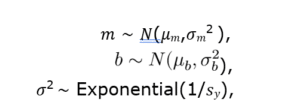
where 𝑚,𝑏,𝜎2 are independent. Students explore posterior distributions and discuss how priors impact their conclusions. A key feature is a sequential analysis, where students select a prior based on one state’s results and apply it to another, showing how prior beliefs shape posterior outcomes.
Classroom Controversy
When the groups compare findings, differing conclusions emerge despite identical data. This “controversy” prompts students to reflect on the role of assumptions in inference. Each group likely thinks their conclusions are “correct” based on their analyses, however it is important to point out that the controversy cannot be resolved. The instructor facilitates a discussion highlighting how neither approach is universally superior; instead, one’s conclusions depend on both the assumptions chosen and the overall purpose of the analysis(Gill and Witko 2013).
Discussion and Activity Extensions
This activity offers a robust, inquiry-based method for teaching frequentist and Bayesian statistics in political science and public policy classrooms. By leveraging the 5E model and real-world data, it equips students with tools to navigate the complexities of statistical inference and fosters deeper, more critical engagement with methodological assumptions.
Our activity situates statistical learning in real-world problems and promotes active engagement. Unlike lecture-based methods, it emphasizes inquiry and critical thinking. To deepen the experience, we propose three ways to expand this activity:
- Have students switch groups to compare methods firsthand.
- Integrate statistical programming in R for advanced students.
- Use different datasets to promote generalizability.
Future research includes surveying students pre- and post-activity to assess changes in epistemological frames. Cultivating the ability to challenge and adopt assumptions will strengthen students’ capacity for applied statistical reasoning.
All materials were created using the programming language R (v4.3.0; R Core Team 2023) and can be rendered in .html or .pdf format for use. The materials, as well as a supplemental appendix, are openly available for instructors on our GitHub repository.[3]
Endnotes
[1] https://screeningtool.geoplatform.gov/en/
[2] https://github.com/bayes-bats/tier2-freq-bayes/tree/main/full-activity
[3] https://github.com/bayes-bats/tier2-freq-bayes
References
APSA. 2017. “2015-2016 American Political Science Association (APSA) Departmental Survey: Undergraduate Enrollments & Curriculum.” https://apsanet.org/wp-content/uploads/2025/01/2015-16-Undergraduate-Enrollments-and-Curriculum-Report.pdf
Bates, Stephen R, and Laura Jenkins. 2007. “Teaching and Learning Ontology and Epistemology in Political Science.” Politics 27 (1): 55–63.
Dogucu, Mine, and Jingchen Hu. 2022. “The Current State of Undergraduate Bayesian Education and Recommendations for the Future.” The American Statistician 76 (4): 405–13.
Duran, Lena Ballone, and Emilio Duran. 2004. “The 5E Instructional Model: A Learning Cycle Approach for Inquiry-Based Science Teaching.” Science Education Review 3 (2): 49–58.
Elby, Andrew, and David Hammer. 2010. “Epistemological Resources and Framing: A Cognitive Framework for Helping Teachers Interpret and Respond to Their Students’ Epistemologies.” Personal Epistemology in the Classroom: Theory, Research, and Implications for Practice 4 (1): 409–34.
Entwistle, Noel. 1997. “Contrasting Perspectives on Learning.” The Experience of Learning 2: 3–22.
Ferrari, Diogo. 2022. “Teaching Bayesian Statistics.” PS: Political Science & Politics 55 (1): 230–35.
Fienberg, Stephen E. 2011. “Bayesian Models and Methods in Public Policy and Government Settings.” Statist. Sci. 26(2): 212-226. DOI: 10.1214/10-STS331
Freedman, David. 1997. “Some Issues in the Foundation of Statistics.” Topics in the Foundation of Statistics, 19–39.
Gill, Jeff, and Christopher Witko. 2013. “Bayesian Analytical Methods: A Methodological Prescription for Public Administration.” Journal of Public Administration Research and Theory 23 (2): 457–94.
Uno, Gordon E. 1999. “Handbook on teaching undergraduate science courses: A survival training manual.”
Samaniego, Francisco J. 2010. A Comparison of the Bayesian and Frequentist Approaches to Estimation. Vol. 24. Springer. v4.3.0; R Core Team. 2023. R: A Language and Environment for Statistical Computing. Vienna, Austria: R Foundation for Statistical Computing. https://www.R-project.org/.
—
Stefani Langehennig is an Assistant Professor of the Practice in the Business Information & Analytics Department at the University of Denver’s Daniels College of Business. Her research focuses on computational social science methods and pedagogy, the impact of data transparency on political behavior, and legislative policy capacity.
Zach del Rosario is an assistant professor of engineering and applied statistics at Olin College. He is a mixed-methods researcher who studies decision making under uncertainty.
Mine Dogucu is Associate Professor of Teaching and Vice Chair of Undergraduate Studies in the Department of Statistics at University of California Irvine. Her work focuses on data science curriculum and Bayesian education in STEM disciplines.
Funding Acknowledgement: All authors were supported by the NSF IUSE: EHR program with award numbers 2215879, 2215920, and 2215709.
Published since 2005, The Political Science Educator is the newsletter of the Political Science Education Section of the American Political Science Association. As part of APSA’s mission to support political science education across the discipline, APSA Educate has republished The Political Science Educator since 2021. Please visit APSA Educate’s Political Science Educator digital collection.
Editors: Colin Brown (Northeastern University), Matt Evans (Northwest Arkansas Community College)
Submissions: editor.PSE.newsletter@gmail.com