Political Science Educator: volume 29, issue 2
Reflections
By Kerri Ryer (ryerkerri@fhda.edu)
Research strongly demonstrates a positive correlation between participation in mentoring programs and student success (Kitchen et al. 2025). Transfer student participation in a mentoring program positively impacts their likelihood of degree attainment (Dinh and Zhang 2021), as well as their self-confidence and academic performance (Hoffman and Wallach 2005). Student participation in mentoring programs increases first-generation student retention (Long et al. 2025) and positively benefits low-income students (Kitchen et al. 2025). Peer-mentoring improves cultural capital and a sense of belonging (Thurman and Tapia 2023) and community (Teshera-Levye and Vance-Chalcraft 2024). These programs help students access others with the success that they seek (Cepeda et al. 2021) and increase their likelihood of research participation, for which they are typically underrepresented in (Reeves et al. 2023). For example, the Security and Political Economy Lab at USC relies on mentoring to improve access to research experiences and overall student retention and success (Becker 2020).
According to Transfer Student Capital (TSC) theory, peers play a significant role in knowledge acquisition needed to successfully navigate the transfer process (Laanan et al. 2010; Lukszo & Hayes 2020). Mentoring programs can help mentees navigate the hidden curriculum. Mentees in peer mentoring programs perceive their peers as less intimidating, more approachable, and more trustworthy compared to faculty (Marshall et al. 2021). Peer-mentoring supplements faculty-student relations in discrete ways, especially as a viable alternative for departments with limited faculty availability for mentoring. For example, Becker (2020) used a multi-level model where freshmen were paired with a research team comprised of a faculty member, PhD student, and a senior. Similarly, community college faculty could partner with university faculty to develop similar multi-level peer-mentoring programs that bring together lower division political science undergraduates with a faculty member, an upper division peer mentor who has transferred to a 4-year institution, and a PhD student.
How can we create these programs? This essay addresses this question by giving some basic guidelines for developing a mentoring program and network, as well as completing an iterative program review. It also provides important templates for all three tasks in an appendix (specifically, Program Goal Statement template, Programming Map template, Program checklist; examples of outreach flyer for recruitment, mentor-mentee pairing survey, mentor training agenda, mentee orientation handout, and mentor/mentee agreement template, program logic model, pre/post participation survey, and budget request template).
Developing a Program
The most important step in developing a successful mentoring program is to identify the program goals: increasing transfer rates, developing skills, increasing graduate school enrollment, or something else. For example, Thurman and Tapia (2023) developed a program to foster a sense of belonging, encourage self-exploration, and build constellations of support by hosting a series of informal social events, workshops focused on personal identity and strengths, one-on-one mentor-mentee meetings, and an opportunities fair. Likewise, mentor programs aimed at increasing access to research opportunities can employ activities like in-lab hours and research partnerships (Becker 2020).
Peer mentoring might address a problematic trend in our discipline. Since 2015, the total number of political science and government undergraduate degrees has increased across the country, while master’s degrees have stagnated and doctorates decreased (IPEDS 2022). In California the number of transfer students completing a bachelor’s in political science in the California State University (CSU) system has exceeded that of first-time freshmen (CSU Data Dashboard). Yet, the total number of degrees earned by the transfer population is lower than it has ever been in the past ten years (CSU Data Dashboard). Peer-mentoring programs could ease the transition from community college to university for political science majors, create a supportive, informed community across institutions, foster professional growth and academic confidence, while highlighting the diverse pathways in political science related fields. Together these aims could improve transfer experiences, bachelor’s degree attainment, and pursuit of graduate degrees in political science. Monthly mentor-mentee check-ins, transfer application workshops, transfer student panels with alumni, campus tours, social events, career pathway conversations, and research teams could support these goals.
Establishing a Network
A variety of models exist for peer mentoring networks. Mentors come from student clubs, honor societies, specific departments, and or the alumni networks. When an institution either does not have enough or even any graduate students to satisfy the need, alumni might satisfy the need (Reeves et al. 2023) or partnerships might be built between colleges and universities (Gilmour 2021). Transfer partnerships between community colleges and four-year universities improves the transfer student experience (Silver 2025), and can be facilitated with transfer agreements, like what takes place between the California Community Colleges (CCC) and CSU according to the Transfer Success Pathway (TSP) or between a CCC and University of California according to a Transfer Alliance Program (TAP). This multi-institution network design could lower the associated program costs while strengthening partnerships and increasing social capital for everyone involved.
The mentor-mentee relationship significantly influences the positive experience of both groups. Mentor-mentee pairing should be done intentionally to promote success. It is important to consider age, race, gender, experience, and background of the participants when making a pairing (Pinkney et al. 2024). In their study of a peer-mentoring program for education majors, Lapin and Buddington (2023) found that first pairing students by first-generation status, then by sports team affiliation, then gender, and finally area of concentration contributed to the positive outcomes associated with the program. The subfield of focus or political science concentration, preferred transfer institution, and desire to pursue graduate education may also be valuable aspects to consider. Additionally, some studies have found that permitting mentees to have some agency in the pairing process can improve their overall experience (Cornelius et al. 2016). It may be worthwhile to have mentors provide background cards and then develop an intake survey process where mentees self-identify and then select three possible mentors for pairing purposes. Incorporating appropriate questions into program entrance and exit surveys could develop these potential pools of mentors and mentees.
Mentor preparation and mentee expectations make for successful programs. Mentor training in the form of a handout, video, or meeting improve the overall experience for both mentees and mentors (Pinkney et al. 2024). Setting clear expectations about the length of commitment, the mentee-mentor ratio, pairing process, and activates for the program must come at the start of any program. For this reason, Cornelius et al. (2016) argue for face-to-face orientation. Additionally, research shows that mentors and mentees prefer regular and frequent meetings and a longer mentoring processes (Cornelius et al. 2016; Lapon and Buddington 2023). Strategic design practices bring about more frequent opportunities for interaction that result in longer-term and more-meaningful relationships.
Iterative Program Review
Program evaluation contributes to program development and implementation. Program evaluation utilizes social research methods to systematically assess the impact of program implementation for ongoing improvement (Rossi et al. 2019). The program review helps justify future budgetary requests. Small rewards for participants might improve outcomes. For example, Becker (2020) offer small coffee shop gift cards to encourage mentees to socialize with their PhD mentor. Other mentoring programs use funds to invite speakers, attend trainings, and hold social gatherings. Programs with a proven track record result in funding, and the program review process produces this needed evidence.
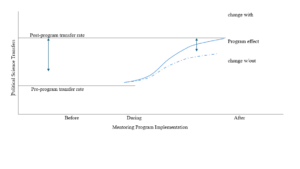
Because of the non-random nature of mentor and mentee selection, an outcomes-based or impact evaluation may be most appropriate. If access to non-participant data is unavailable, it might be best to use an outcomes level assessment, where the outcome level is measured before the program, during the program, and after the program. For example, if one of the programmatic goals is to improve the total number of political science students that transfer to a four-year institution, the total number would be traced from before the program, during, and after implementation. The change in the outcome from the expected value without implementation to the actual change with implementation would measure the program effect. See visualization below:
On the other hand, if access to non-participant data is available, an impact evaluation could be appropriate. If one of the aims is to increase the likelihood that political science majors will pursue graduate degrees, evaluators could trace the academic paths of political science majors and group them according to participation and non-participation. A quasi-experimental method could be used for an assignment. Then the outcomes measured after treatment (i.e., the number of students who entered a graduate degree program) could be compared across the treatment and comparison group to measure the program effect. Iterative program evaluation is important to ensure the actualization of the mentoring program goals, produce continuous improvement, and the justify program resource allocation.
Conclusion
Peer-to-peer mentoring programs improve transfer experiences and increase student success. A multi-institutional multi-level mentoring program addresses the problematic downward trend in transfer student degree attainment in political science. Successful mentoring programs require strategic design with clearly stated goals and iterative evaluation procedures to measure the program effect, intentional mentor-mentee pairing, and training and orientation designed to produce clear expectations in effective programs. While mentoring programs exist within political science departments across the United States, adoption of the peer-to-peer model remains limited. Widespread institutional integration of mentoring programs could produce rich qualitative and quantitative data, that could help better understand the factors contributing to student success and pursuit of advanced degrees in political science, like identifying the largest areas of need for different demographics of early career political scientists.
References
Becker, Megan. 2020. “Importing the Laboratory Model to the Social Sciences: Prospects for Improving Mentoring of Undergraduate Researchers.” Journal of Political Science Education 16(2): 212-224. doi: 10.1080/15512169.2018.1505523.
Cepeda, Rebecca, Buelow, Melissa T., Jaggars, Shanna S., and Marcos D. Rivera. 2021. “Like a Freshman Who Didn’t Get a Freshman Orientation: How Transfer Student Capital, Social Support, and Self-Efficacy Intertwine in the Transfer Student Experience.” Frontiers in Psychology 12(767395): 1-15. doi: 10.3389/fpsyg.2021.767395
Cornelius, Vanessa, Wood, Leigh, and Jennifer Lai. 2016. “Implementation and Evaluation of a Formal Academic-peer-mentoring Program in Higher Education.” Active Learning in Higher Education 17(3): 193-205. https://doi.org/10.1177/1469787416654796
CSU Data Dashboard. n.d. “CSU Degrees Issued by Major.” CSU. https://tableau.calstate.edu/views/CSUDegreesIssued/CSUDegreesIssued?%3Aembed=y&%3Aiid=1&%3AisGuestRedirectFromVizportal=y.
Dinh, Trang V., and Yi Leaf Zhang. 2021. “Engagement in High-Impact Practices and Its Influence on Community College Transfers’ STEM Degree Attainment.” Community College Journal of Research and Practice 45(11): 834-849. https://doi.org/10.1080/10668926.2020.1824133
Gilmour, Terry L. 2021. “Community College and University Partnerships for the Political Science Major.” PS: Political Science & Politics 54(2): 373-376. https://doi.org/10.1017/S1049096520001857
Hoffman, August John, and Julie Wallach. 2005. “Effects of Mentoring on Community College Students in Transition to University.” Community College Enterprise 11(1): 67-78. https://www.schoolcraft.edu/pdfs/cce/11.1.67-78.pdf
IPEDS. 2022. “Degrees in Economics, History, Political Science and Government, and Sociology Conferred by Postsecondary Intuitions, by Level of Degree: Selected Academic Years, 1949-2020.” National Center for Education Statistics: Digest of Education Statistics. https://nces.ed.gov/programs/digest/d22/tables/dt22_325.92.asp
Kitchen, Joseph A., Culver, K. C., Rivera, Gwendelyn, and Zoe B. Corwin. 2025. “Promoting Low-Income College Student Success through Peer Mentoring: A Mixed Methods Examination.” Teachers College Record 127(2): 103-140. https://doi.org/10.1177/01614681251334786
Laanan, Frankie Santos, Starobin, Soko S., and Latrice E. Eggleston. 2011. “Adjustment of Community College Students at a Four-year University: Role and Relevance of Transfer Student Capital for Student Retention.” Journal of College Student Retention 12(2): 175-209. https://doi.org/10.2190/CS.12.2.d
Lapon, Elizabeth, and Leslie Buddington. 2023. “The Impact of Peer Mentoring in First-year Education Students.” International journal of Mentoring and Coaching in Education 13(1): 73-87. doi: 10.1108/IJMCE-01-2023-0002.
Long, Maryanne, Contereras Aguirre, Hilda Cecilia, and Martinez Miller, Concepcion. 2025. “Rethinking Persistence: Evaluating Peer Mentoring on Community College Students’ Academic and Social Integration.” Community College Journal of Research and Practice 1-3. https://doi.org/10.1080/10668926.2025.2506145
Lukszo, Maliszewski, and Shannon Hayes. 2020. “Facilitating Transfer Student Success: Exploring Sources of Transfer Student Capital.” Community College Review 48(1): 31-54. https://doi.org/10.1177/009155211987601
Marshall, Mary, Dobbs-Oates, Jennifer, Kunberger, Tanya, and Jackie Greene. 2021. “The Peer Mentor Experience: Benefits and Challenges in Undergraduate Programs.” Mentoring & Tutoring: Partnership in Learning 29(1): 89-109. https://doi.org/10.1080/13611267.2021.1899587
Pinkney, Justyce, Charlot, Larousse, Samuels, Shalander, and Amanda Wilkerson. 2024. “Making Mentoring Work: A Case Study of the Intersections of Peer Mentoring at a Hispanic Serving Institution.” Journal of Underrepresented and Minority Progress<8(SI): 109-133. https://doi.org/10.32674/jump.v8isi1.5923
Reeves, Audrey, G., Bischoff, Amanda J., Yates, Brice, Brauer, Daniel D., and Anne M. Branger. 2023. “A Pilot Graduate Student-Led Near-Peer Mentorship Program for Transfer Students Provides a Supportive Network at an R1 Institution.” Journal of Chemical Education 100: 134-142. https://doi.org/10.1021/acs.jchemed.2c00427
Rossi, Peter H., Lipsey, Mark W., and Gary T. Henry. 2019. Evaluation: A systematic approach, 8th edition. Los Angeles, CA: Sage.
Silver, Blake R. 2025. “Transfer Partnerships, Transfer Capital, and Student Experiences of Vertical Transfer.” Community College Review 0(0): 1-19. https://doi.org/10.1177/00915521251338828
Teshera-Levye, Jennifer, and Heather D. Vance-Chalcraft. 2024. “Peer Mentorship and Academic Supports Build Sense of Community and Improve Outcomes for Transfer Students.” Journal of Microbiology & Biology Education 25(1): 1-14. https://doi.org/10.1128/jmbe.00163-23
Thurman, Sabrina L. and Oscar R. Miranda Tapia. 2023. “Considerations for Designing and Implementing a First-Generation College Student Peer Mentoring Program.” Journal of First-Generation Student Success 3(2): 143-153. https://doi.org/10.1080/26906015.2023.2231024
—
Kerri Ryer is an Associate Professor and Chair of the Department of Political Science at Foothill College.
Appendix for Pathways to Political Science Mentoring Program
Published since 2005, The Political Science Educator is the newsletter of the Political Science Education Section of the American Political Science Association. As part of APSA’s mission to support political science education across the discipline, APSA Educate has republished The Political Science Educator since 2021. Please visit APSA Educate’s Political Science Educator digital collection.
Editor: Matt Evans (Northwest Arkansas Community College)
Assistant Editor: Colin Brown (Northeastern University)
Submissions: editor.PSE.newsletter@gmail.com