Resource Collection
Connecting Community and Classroom: Practical Considerations for Civically-Engaged Practitioners and Scholars
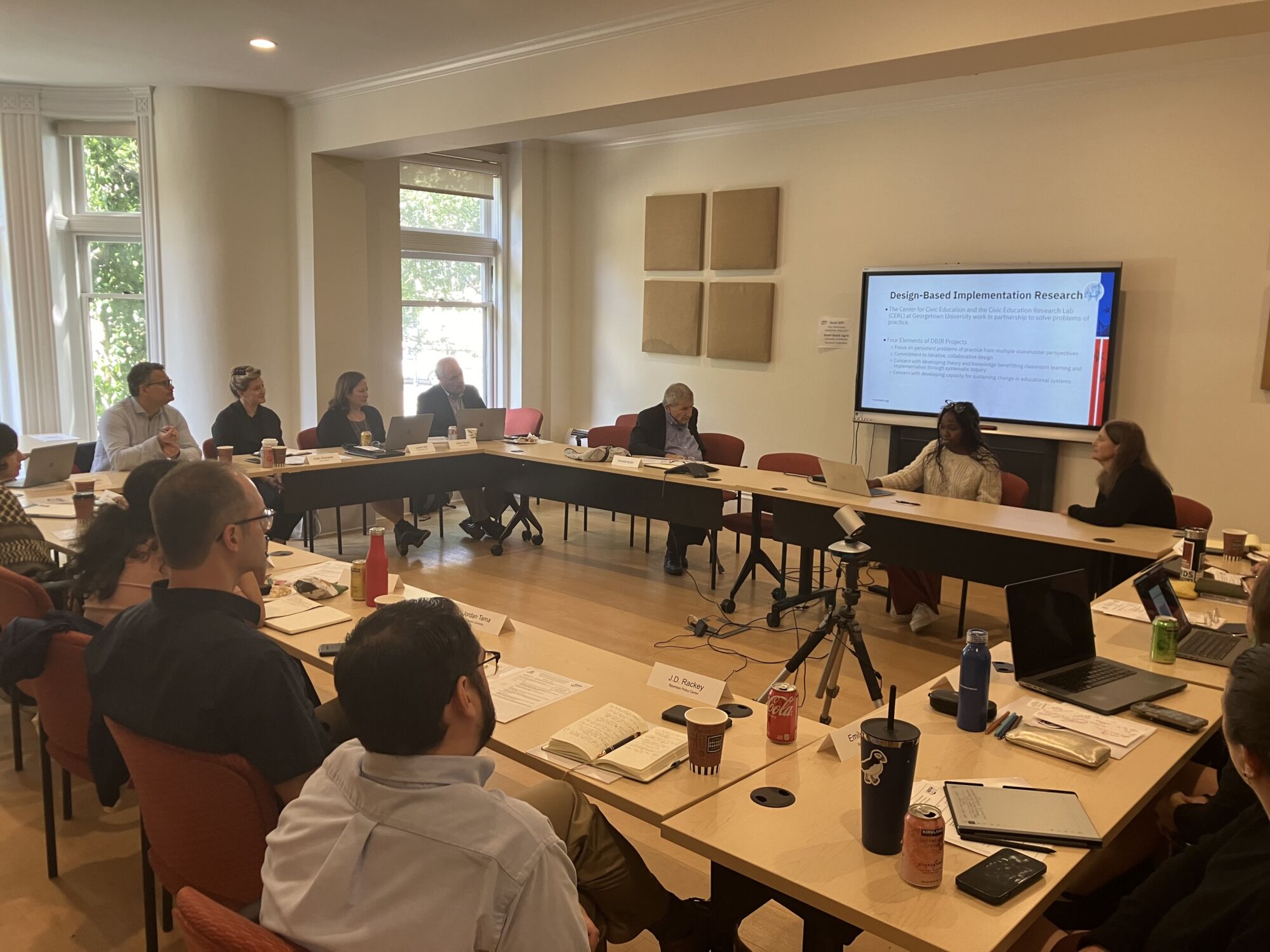
On Saturday, October 5th, 2024, the National Capital Area Political Science Association and the American Political Science Association held the workshop "Connecting Community and Classroom: Practical Considerations for Civically-Engaged Practitioners and Scholars." The workshop, led by Lauren Bell (Randolph-Macon College) and John Forren (Miami University), brought together scholars and practitioners committed to civic education to collaborate, build supportive relationships, and share practical guidance for leading community-engaged projects. This resource collection shares each presenter's slides and supplemental resources.
Empowering Young Student Voters: Collaborations with Local Election Officials, Faculty, Student Leaders, and University Administrators
Thessalia Merivaki, Georgetown University
This project showcases an initiative led by Political Science faculty at Mississippi State University, with financial support by Scholars Strategy Networks’ Election Protection and Enhancement Program (2022), to establish a non-partisan voter education and outreach program, leveraging existing and ongoing partnerships with faculty, administrators, student leaders, state and local election officials, and local/regional and national media outlets to build on initiatives implemented by faculty and students in the Department of Political Science and Public Administration, such as peer-to-peer voter registration drives and Get Out The Vote events.
Teaching Public Opinion through Civically-Engaged Research
Emily Sydnor, Syracuse University
In the last few years of my tenure at Southwestern University, I adapted my upper-level research course on public opinion and American politics into a civically-engaged research course. Drawing on principles from community engaged learning and my experience in APSA’s Institute for Civically Engaged Research, students in my Fall 2022 and Spring 2024 classes worked with two sets of nonprofit leaders in Georgetown, TX to develop a survey questionnaire, administer it electronically and provide a basic analysis of the results. In Fall 2022, we partnered with RISE Georgetown, a nonpartisan organization whose goal is to elect student-focused school board members, to investigate what members of our community knew about school board elections, the role of school board officials, and how that influenced their voting behavior. In Spring 2024, we collaborated with a group of nonprofit leaders from a range of organizations to design a survey about nonprofit employee compensation and those employees’ attitudes towards their jobs.
View the Course Syllabus, Reflection Assignment, and Research Paper Prompt Here
School Participatory Budgeting in Arizona: Examining Partnerships and Lessons From Three Case Studies
Tara Bartlett, Arizona State University
In 2013, Bioscience High School in the Phoenix High School District (PXU), one of Arizona's largest and most diverse school districts, piloted the School Participatory Budgeting (SPB) process in partnership with Arizona State University's Participatory Governance Initiative (PGI), the Center for the Future of Arizona (CFA), and the Participatory Budgeting Project (PBP). This initiative aimed to directly involve student voice and choice in allocating a portion of the school budget. Recognizing the potential of SPB to enhance citizenship education, civic engagement, and school democracy, PGI and CFA partnered with K-12 schools to promote and expand the initiative across the state by providing resources, training, and support to schools interested in implementing the process. This expansion included information workshops, training sessions for teachers and students, and the development of toolkits to guide schools through the process of implementing SPB. The success of the initial SPB process has led to increased interest and the gradual adoption of SPB in other schools within Arizona. To date, over 70 Arizona schools have implemented SPB, with students leading decisions on budget allocations for projects they deem important. This presentation discusses three SPB case studies to demonstrate the critical leverage of partnerships and lessons learned during different SPB processes.
New Voices in National Security: An Innovative Format for Bringing Together Scholars and Practcioners to Exchange Knowledge and Ideas
Jordan Tama, American University
This presentation explores how Bridging the Gap, a multi-university initiative, has implemented a New Voices in National Security program to directly connect scholars and practitioners focused on national security issues. The program has convened more than a dozen workshops on an array of international political problems in partnership with policy institutions, government agencies, and think tanks. The New Voices program is motivated by the recognition that many scholars have policy-relevant expertise but do not have the training or connections needed to share their policy insights with practitioners and the observation that policy officials tend to rely on the same set of experts in Washington. This presentation discusses how the New Voices Program was designed and conducted, the program's outcomes, and lessons learned.
Leafing a Mark: Exploring the Intersection of Modern Tree Canopy and Historic Redlining for Inclusive Community Revitalization
Jayme Renfro, University of Northern Iowa
"Leafing a mark" is a collaborative class-based project initiated at the University of Northern Iowa in the Spring of 2024 and aimed at addressing environmental justice and public engagement by examining the historical impacts of redlining on modern urban tree canopy distribution in Waterloo, IA. This project integrates hands-on research, community collaboration, and practical application, offering students a comprehensive learning experience. This project stems from a growing recognition of the long-term impacts of redlining, a discriminatory practice that historically marginalized certain neighborhoods, leading to significant disparities in urban infrastructure and resources, including tree canopy coverage. In Waterloo, IA, these practices have resulted in areas with limited green spaces, impacting community health and quality of life. By combining historical analysis with practical environmental action, this project aims to address these inequities, giving the East side of Waterloo more tree coverage, while teaching students about the long-term effects of historic policies and also about planning large-scale projects.
Promoting Quality Civic Education through Design-Based Implementation Research
Diana Owen, Georgetown University
Meghan Volcy, Center for Civic Education
Georgetown University’s Civic Education Research Lab (CERL) has been working closely with the Center for Civic Education on design-based implementation research (DBIR) projects to improve elementary and secondary school civic education since 2015. Researchers and practitioners employing DBIR work collaboratively to identify problems and strategies while simultaneously implementing a project and conducting research so that issues can be addressed iteratively in real-time. The partnership revolves around the Center’s work in developing and implementing curricular programs that employ active learning pedagogies and project-based learning. CERL performs the project evaluations and works collaboratively with the Center to provide feedback that informs program development to improve student outcomes in a range of settings and to facilitate project scalability. CERL and the Center have been concentrating their efforts on programs that address the requirements of high-need students, including emerging multilingual learners (ML), students living in poverty, students with disabilities (SWD), and students of color (SOC). This presentation focuses on the collaboration between the Center and CERL on two large-scale projects—the James Madison Legacy Project Expansion (JMLPE) and the Project Citizen Research Project (PCRP)—that are distinctive yet have complimentary objectives and outcomes.
View Georgetown University's Civic Education Research Lab here