Political Science Educator: volume 29, issue 2
Reflections
By Diana Owen (owend@georgetown.edu), Jamie Joseph (jj1173@georgetown.edu), Naomi Rader (nr757@georgetown.edu), and Patrick McSweeney (prm65@georgetown.edu)
At Georgetown University’s Civic Education Research Lab (CERL), we use data to tell the story of the transformative power of civic education. However, the storytelling should not stop with us. Quality data are essential for teachers, administrators, and policymakers to arrive at informed decisions about curricula, pedagogy, and resource allocation. Yet, researchers often fail to convey data in a way that is most useful and interpretable to key stakeholders. The impact of research on education practice and policy can be greatly enhanced when educators are actively involved in data dissemination–when they tell the story.
Research findings are frequently disseminated without consideration of the specialized needs of the audiences they are intended to reach. Investigators, especially those at universities, tend to orient their reports, papers, and publications toward academic audiences (Areljung et al. 2021, Vanderlinde and van Braak 2009). Presentations of study results are often one-sided, as researchers recount statistical findings devoid of context to educators without offering meaningful opportunities to reflect on their relevance (Darling-Hammond, Hyler, and Gardner 2017). A wide range of constituencies benefit from civic education research, requiring that findings be distributed in a variety of formats. Study reports and publications must maintain high standards of academic rigor as they form the basis of subsequent dissemination efforts. Data storytelling grounded in meticulous scholarly work can be an effective tool for reaching different stakeholders. Storytelling encompasses the use of critical information to create a captivating narrative that informs and influences a target audience (Matei and Hunter 2021).
It can be difficult for researchers to fully understand best practices for data use by practitioners, and CERL is certainly no exception. We came to recognize that comprehending the composition, needs, and goals of the civic educators we want to reach is vital to the success of our work. When disseminating our research, it is imperative that we ask: Who is using the data? For what purpose? In what context? And with what desired outcome? Fortunately, research specialists on the CERL team have elementary and secondary school teaching experience. We brainstormed about ways to get teachers involved in telling the story of our data and created a professional learning session entitled Campaigning for CEAS: Using Data & Design to Create a Compelling Story[1] to actively engage educators in data storytelling. We implemented this activity at a workshop convened by the Center for Civic Education[2] for the We the People: Civics that Empowers All Students[3] (CEAS) program, an initiative that supports effective educator development through the Center’s flagship We the People curriculum. The workshop was held in Los Angeles in March 2025. CERL is the independent evaluator of the CEAS program which was funded by a grant from the U.S. Department of Education. This essay provides an overview of the activity we used to engage teachers with the data, as well as resources.
The workshop was attended by mentor teachers who work with classroom educators enrolled in CEAS and state coordinators who support the Center’s programs nationwide. The CEAS program provides professional development to guide upper elementary and middle school teachers in using the We the People curriculum with their students. CERL’s research evaluates the effectiveness of the CEAS professional development program in improving teachers’ civic knowledge and pedagogy. It also assesses the impact of the We the People intervention on students’ civic knowledge, skills, and dispositions.
We began the session by presenting CERL’s research findings on the impact of CEAS on teachers and students who had participated in the program. We provided workshop participants with a [4] that included data visualizations and a summary of key points of our presentation. We asked them to take a deeper look at the research and identify the data that would be most useful if they were to advocate for using the We the People curriculum in their own classrooms, schools, districts, or states. Working in groups, the educators combined the data presented by CERL with their personal reflections to create a poster. Groups began by identifying their target audience–parents, teachers, school administrators, district leaders, or state policymakers (activity instructions[5]). Next, groups determined the goal of their poster. Were they trying to inform parents of the program’s success? To recruit other educators to participate in the study? To convince administrators to adopt We the People as a district wide curriculum? Or were they trying to advocate for policies that provide funding for civic education at the state-level? The data visualizations, included in the handout, could be customized, cut, and pasted onto their poster. Since qualitative evidence is essential for data storytelling, we asked groups to reflect on their experiences with CEAS and include a quote from their discussion on their poster.
Figure 1a and 1b: Innovation Hub
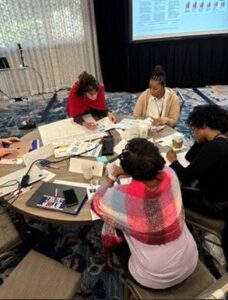
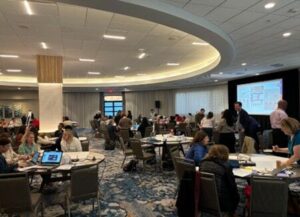
Each table buzzed with creative ideas as the activity transformed the conference room into an innovation hub (Figures 1a and 1b above). Groups were provided with poster boards, stickers, markers, and other craft supplies. Educators dove headfirst into the research, collaborating to determine what data best illustrated the impact of CEAS to reach their target audience and goals. While all posters emphasized that We the People students had gained civic knowledge and skills, each poster told its own story, capturing unique perspectives on the program’s impact. Common themes emphasized the need to start civic education early and the benefits of We the People in teaching 21st century skills.
Figure 2: Civics Teaches Everything
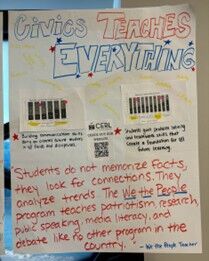
A poster entitled “Civics Teaches Everything” (Figure 2 above) emphasized how the communication skills students built through We the People can translate to “all fields and disciplines.” This group identified how problem solving and teamwork skills create a “foundation for future learning.” They expressed the importance of the program’s active learning strategies to advocate for its implementation in schools. This emphasis reflects the findings of prior research, including CERL’s studies, that establishes a positive relationship between active pedagogies and civic learning outcomes (Owen and Irion-Groth 2024; Kozanitis and Nenciovici 2023).
Figure 3: Everyone Wins
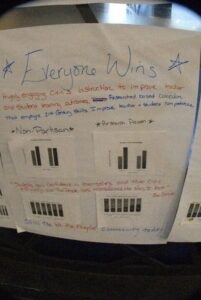
Another poster entitled, “Everyone Wins” (Figure 3 above) highlights improvement in students’ confidence and civic efficacy. This poster’s creators aimed to reach teachers who might be discouraged or intimidated by the competitive components of the We the People program which culminates in simulated congressional .[6] The hearings are the We the People’s cumulative performance-based assessment that has students apply their understanding of constitutional principles by analyzing, forming, and defending positions on historical and contemporary issues. Classes have the potential to participate in district, state, and national civics competitions, although this is not a program requirement. Simulations are a powerful pedagogical tool as they engage students in real-world processes, in this case a congressional hearing. This enhances learning by moving students away from the passive intake of knowledge and toward active, higher-order analysis. Congressional simulations are particularly effective, as they help students grasp the deliberative dimensions of the legislative process and apply their constitutional knowledge in real time (Sands and Shelton 2010). Even with the competitive nature of hearings, the poster reminds us that all students will win the prize of enhanced civic knowledge and skills.
Figure 4: CEAS the Day
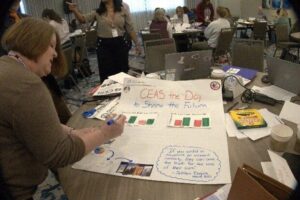
Lastly, the poster “CEAS the Day to Shape the Future” (Figure 4 above) was created to persuade policy makers to “Invest the time to grow civic minds.” This group emphasized the discrepancy between time spent on social studies compared to other subjects and calls for policy makers to invest in civic education. Civic education has been pushed to the side, especially in early grades, with schools prioritizing math and literacy due to their importance in high stakes testing (Fitchett, Heafner, and Lambert 2012). This is a missed opportunity as civic education at the elementary level can impart the civic knowledge and skills that will continue to develop over a lifetime (Moses 2024; Swalwell and Payne 2019). The results from CEAS are further evidence that civic education can be a difference maker.
Figure 5: Gallery Walk
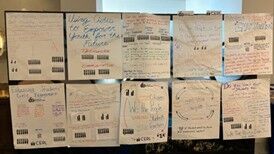
The session culminated in a gallery walk (Figure 5 above) to celebrate the creative and persuasive visualizations which sparked meaningful conversations. Educators took the last 10 minutes to view each group’s poster, leaving sticky notes with comments, questions, and suggestions. This cross-group engagement helped educators understand how civic education data might be used across educational contexts, while also identifying ways to strengthen their own work. The exercise generated positive feedback in the moments and months following the session. A participant observed, “This is interesting because if you were trying to sell this to a district, or sell it to teachers, or trying to get people to do it, that was really good info, that was really good research.” Another noted, “This activity helped make the connection between what the aim of the program was and what the actual results are.”
We encourage researchers and educators to find creative ways to bridge the gaps between research, policy, and practice and to make data accessible and useful to stakeholders. This hands-on activity left participants with deeper insights into the data and provided CERL with a better understanding of what stories educators seek to tell. It was inspiring to see educators creatively integrate data into powerful stories that advocate for civic education. When we infuse the voices of educators into the research process and equip them with the tools for data-driven advocacy, we co-create meaningful, impactful, and sustainable education programs.
References
Areljung, Sofie, Lotta Leden, and Jonna Wiblom. 2021. “Expanding the notion of ‘ownership’ in participatory research involving teachers and researchers.” International Journal of Research & Method in Education, 44(5), 463-473.
Darling-Hammond, Linda, Maria E. Hyler, and Madelyn Gardner. 2017. “Effective Teacher Professional Development.” Learning Policy Institute.
Fitchett, Paul G., Tina L. Heafner, and Richard G. Lambert. 2014. “Examining Elementary Social Studies Marginalization: A Multilevel Model.” Educational Policy 28(1): 40–68. doi:10.1177/0895904812453998.
Kozanitis, Anastassis, and Lucian Nenciovici. 2023. Effect of Active Learning Versus Traditional Lecturing on the Learning Achievement of College Students in Humanities and Social Sciences: A Meta-Analysis. Higher Education, 86, 1377–1394. https://doi.org/10.1007/s10734-022-00977-8
Matei, Sorin Adam, and Lucas Hunter. 2021. “Data Storytelling Is Not Storytelling with Data: A Framework for Storytelling in Science Communication and Data Journalism,” The Information Society 37(5): 312-322. https://doi.org/10.1080/01972243.2021.1951415
Moses, Annie. 2024. “Knowledgeable and Engaged Young Citizens: Social Studies in Early Childhood,” Young Children, vol. 79, no. 1: online. https://www.naeyc.org/resources/pubs/yc/spring2024/social-studies-early-childhood
Owen, Diana, and Alissa Irion-Groth. 2024. “Preparing Students for Civic Engagement through Project Citizen,” paper prepared for presentation at the Annual Meeting of the American Political Science Association, Philadelphia, PA, September 6. https://preprints.apsanet.org/engage/apsa/article-details/66d31fb120ac769e5f762ed1
Sands, Eric C., and Allison Shelton. 2010. “Learning by Doing: A Simulation for Teaching How Congress Works.” PS: Political Science & Politics 43(1): 133–38. doi:10.1017/S1049096510990690.
Swalwell, Katy, and Katerina A. Payne. 2019. “Critical Civic Education for Young Children: Multicultural Perspectives,” Multicultural Perspectives, vol. 21, no. 2: 127-132. https://www.tandfonline.com/doi/full/10.1080/15210960.2019.1606641
—
Dr. Diana Owen, Director and Principal Investigator of CERL, is Professor of Political Science in the Communication, Culture & Technology program at Georgetown University. She embraces an interdisciplinary approach to research that is grounded in political science, education research, and communication studies. Her current academic research focuses on how civic education prepares young people for citizenship in the digital age. She also studies the evolution of new political media and its consequences for the public and the polity. Dr. Owen has published widely in the fields of political socialization and civic education, media and politics, political engagement, and elections and voting behavior. She is the principal investigator for research on major projects funded by the U.S. Department of Education in communication with the Center for Civic Education.
Jamie Joseph is a research specialist with CERL at Georgetown University, her research interest in civic education is driven by her deep passion for history, culturally responsive teaching, youth empowerment, and community engagement. She earned a B.A. in Urban Geography with a minor in Community, Youth, and Education Studies, as well as a Master of Arts in Teaching Secondary History, both from Clark University.
Naomi Rader is a research specialist with CERL at Georgetown University, her research interests focus on classroom interventions and curriculum that can be leveraged to promote civic and social-emotional learning. She earned a B.A. in Psychology with minors in Business Administration and History from Christopher Newport University and a M.Ed. in Educational Psychology from the University of Virginia.
Dr. Patrick McSweeney is a research specialist at CERL and an adjunct lecturer in the Government department. He completed his Ph.D. at Georgetown University in 2024, where his dissertation explored generational conflict within the Democratic Party. His broader research focuses on the political attitudes, participation, and representation of young people. Patrick’s work is a constant reminder of the power of young people, and he sees civic education as a crucial tool for preparing the next generation to make a difference.
[1] https://drive.google.com/drive/folders/1DqghNQAHCqlsM0JcM2JqgA5SD0Kii0RE?usp=drive_link
[3] https://www.civiced.org/ceas
[4] https://drive.google.com/file/d/1h1pq0gNIUlKz3tkkEZXXpfN1hqtFVa1S/view?usp=drive_link
[5] https://drive.google.com/file/d/19FCBra_pYlOKFTUza9cpaOoc1egBV5Qg/view?usp=drive_link
[6] https://civiced.org/we-the-people/hearings
Published since 2005, The Political Science Educator is the newsletter of the Political Science Education Section of the American Political Science Association. As part of APSA’s mission to support political science education across the discipline, APSA Educate has republished The Political Science Educator since 2021. Please visit APSA Educate’s Political Science Educator digital collection.
Editor: Matt Evans (Northwest Arkansas Community College)
Assistant Editor: Colin Brown (Northeastern University)
Submissions: editor.PSE.newsletter@gmail.com