Call for Proposals | Civic Education and America’s 250th | Start Your Application Here | APSA, Washington, D.C., June 25-27, 2026
Application Deadline: April 5, 2026
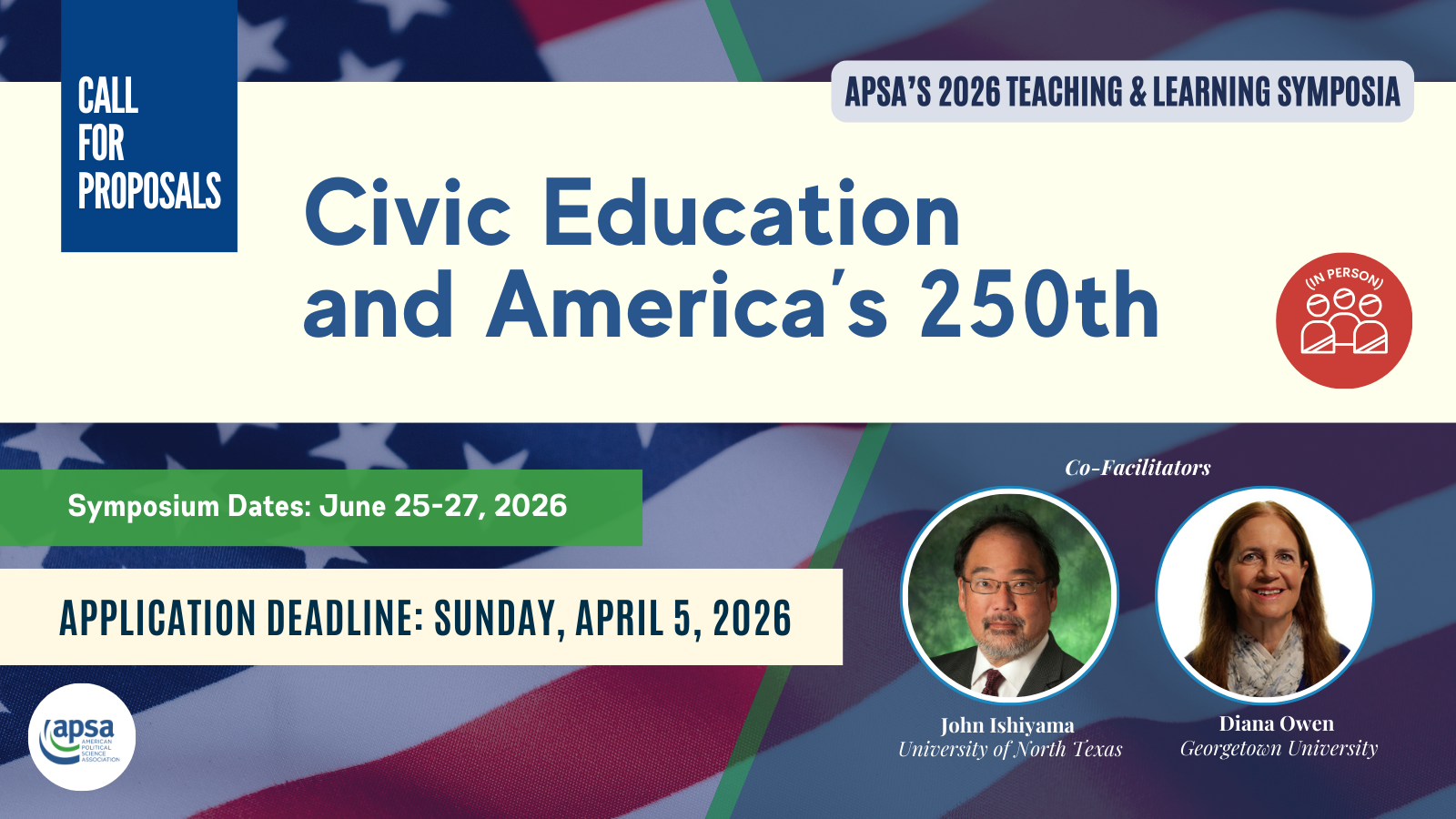
The American Political Science Association’s (APSA) Teaching and Learning Program is pleased to announce a call for proposals for approximately 15 to 20 political science educators and scholars to participate in a three-day symposium focused on civic education pedagogy and research in conjunction with America’s 250th Anniversary on June 25 – June 27 at APSA’s headquarters in Washington, DC. The purpose of this symposium is to share approaches to civics instruction, including evidence-based practices, and to develop pedagogical materials for educators in the context of America’s 250th. The symposium will be led by John Ishiyama (University of North Texas) and Diana Owen (Georgetown University).
Workshop Details
- Date: June 25-27, 2026
- Location: APSA Headquarters, Washington, D.C.
- Registration fee: $85 for APSA members and $100 for non-members
- Application Deadline: Sunday, April 5, 2026
The symposium has the following goals:
- To share innovative approaches to civics instruction and scholarship at the K-12 and post-secondary levels in relation to America’s 250th.
- To provide an inclusive space where participants can build supportive relationships with other educators and scholars who teach civic education courses and/or study the impact of civics instruction on student learning.
- To present, discuss, and co-create innovative curricular interventions, class activities, extracurricular activities, readings, or assignments for meaningful civics instruction related to America’s 250th.
- To contribute teaching materials to an APSA Educate resource collection on political science education.
America’s 250th offers a special opportunity to intensify our commitment to preparing students to be engaged democratic community members. Educators can ensure that students receive civics instruction grounded in American history, founding principles, and a democratic vision for America’s future. At the same time, the country is facing unprecedented challenges and uncertainty that will impact generations to come. Civic educators have the potential to elevate the prospects for democratic life and governance while working to overcome the difficulties we are facing at this historic juncture. To this end, this symposium brings together a small cohort of civic education teachers and scholars to workshop, co-create, and discuss instructional techniques and strategies, curricular interventions, and resources.
This symposium is particularly interested in addressing questions related to civics instruction:
- How can America’s 250th provide a meaningful context for civic learning?
- What are the assumptions underlying civic education from the Founding to the present? How do these assumptions influence current civics instruction?
- Are there innovative interventions, pedagogies, and resources that enhance civic learning, especially in relation to America’s 250th?
- How can civic knowledge, skills, and dispositions that support democracy be effectively conveyed to students so that they have a lasting impact?
- What are best practices for civics instruction in the current era?
- How can research inform the development of quality civics curricula and pedagogy?
- What can K-12 and post-secondary educators learn from each other about effective civics pedagogies?
- How can civic educators respond meaningfully to current events and consider their relationship to historical circumstances?
We encourage applications from political scientists and civic educators at all stages of their careers and graduate students from a range of institutions, including universities and two- and four-year colleges. Civic education practitioners who are APSA members are invited to apply, especially if they collaborate with political scientists.
APPLICATION DEADLINE: April 5, 2026
Proposals should be submitted online and include:
- A brief, recent CV that includes teaching experience
- 250-word abstract summarizing the topic you plan to present at the symposium and the resources that you plan to share
- 250-word description of your motivation and goals for participating in the symposium
Successful applicants will be notified by the middle of April. APSA will provide a limited number of travel grants. For more information, see our FAQs and/or contact teaching@apsanet.org or Michelle Allendoerfer at mallendoerfer@apsanet.org with any questions.
Meet the Co-Facilitators
 Diana Owen, is Professor of political science teaching in the Communication, Culture, and Technology graduate program. She is the Director and Principal Investigator of the Civic Education Research Lab at Georgetown University (https://cerl.georgetown.edu/). She served as Director of Georgetown’s American Studies Program for almost a decade. She is the author of Media Messages in American Presidential Elections (Greenwood, 1991), New Media and American Politics (with Richard Davis, Oxford, 1998), and American Government and Politics in the Information Age (with David Paletz and Timothy Cook, 5th edition, 2022). She is the co-editor of The Internet and Politics: Citizens, Voters, and Activists (with Sarah Oates and Rachel Gibson, Routledge, 2006); Making a Difference: The Internet and Elections in Comparative Perspective (with Richard Davis, Stephen Ward, and David Taras, Lexington, 2009); and Internet Election Campaigns in the United States, Japan, South Korea, and Taiwan (with Shoko Kiyohara and Kazuhiro Maeshima, 2019). She is the author of numerous journal articles and book chapters in the fields of civic education and engagement, media and politics, political socialization, elections and voting behavior, and political psychology/sociology. She has conducted studies funded by the Pew Charitable Trusts, the Center for Civic Education, The Diplomatic Reception Rooms of the United States Department of State, the Bill of Rights Institute, Google, Storyful, and others. She is the recipient of five competitive grants from the U.S. Department of Education in collaboration with the Center for Civic Education, including a Supporting Effective Educator Development Grant for the James Madison Legacy Project, the Presidential and Congressional Academies grant, an Institute for Education Sciences grant for the Project Citizen Research Project, an Education and Innovation Research grant for the James Madison Legacy Project Expansion, and a Supporting Effective Educator Development Grant for the Civics for All project. These grants fund programs and research on civic education for high need students nationwide. Her current research explores the relationship between civic education and political engagement over the life course and new media’s role in politics. She has been an American Political Science Association Congressional Media Fellow. She is the recipient of the Daniel Roselle Award of the Middle States Council on the Social Studies.
 John Ishiyama, is the Piper Professor of Texas and University Distinguished Research Professor of Political Science and Chairperson of the Department of Political Science at the University of North Texas. He studies comparative politics, particularly the party structure and democratization of Post-Soviet states, as well as the politics of Ethiopia. He was the founding editor of the Journal of Political Science Education and the editor in chief of the American Political Science Review (2012-2016). He is a past President of the American Political Science Association.
Visit APSA’s Teaching Symposia page for information about this program and to view past events.