Colin Brown, Northeastern University, co-editor, Political Science Educator Research notes, reviews, and reflections are all welcome for the next Political Science Educator, a newsletter of the Political Science Education Section of the American Political Science Association, to be further distributed on APSA Educate. Research notes should be considered as working papers and have not undergone…

Deadline Extended: Wednesday, January 10, 2024 CALL FOR PROPOSALS: APSA Teaching & Learning Symposium February 16-17 & 22, 2024 Virtual The American Political Science Association’s (APSA) Teaching and Learning program is pleased to announce a call for proposals for a small group of political scientists to participate in a three-day virtual teaching and learning symposium…

Bobbi Gentry, Bridgewater College Recently, I had a conversation with a colleague who asked me about my research process. They wanted to know how I was able to be so productive in my scholarship, even though we both teach at a small liberal arts college with a three/four load. Recognizing that this is a struggle…
By: Jonathan Ring, Deborah Toscano, Isaac Kamola, John Holder, and Eunsook Jung (2022-2023 Committee on the Status of Contingent Faculty in the Profession) The past several years have witnessed a profound “adjuntification” of professoriate, within the discipline of Political Science and across the profession. While higher education has always included gross disparities in terms of…

Deadline Extended to October 3, 2023!! APSA Teaching & Learning Symposium November 3, 4, and 17, 2023 The American Political Science Association’s (APSA) Teaching and Learning program is pleased to announce a call for proposals for a small cohort of political scientists to participate in a virtual teaching and learning symposium in November 2023. APSA’s…

Research collaboration between political science faculty and undergraduate students is often identified as a goal of instructors and departments, but can be difficult to successfully implement. As part of National Undergraduate Research Week (April 17 – April 21, 2023), APSA and Pi Sigma Alpha convened a webinar illuminating best practices, unexpected challenges, and the benefits…
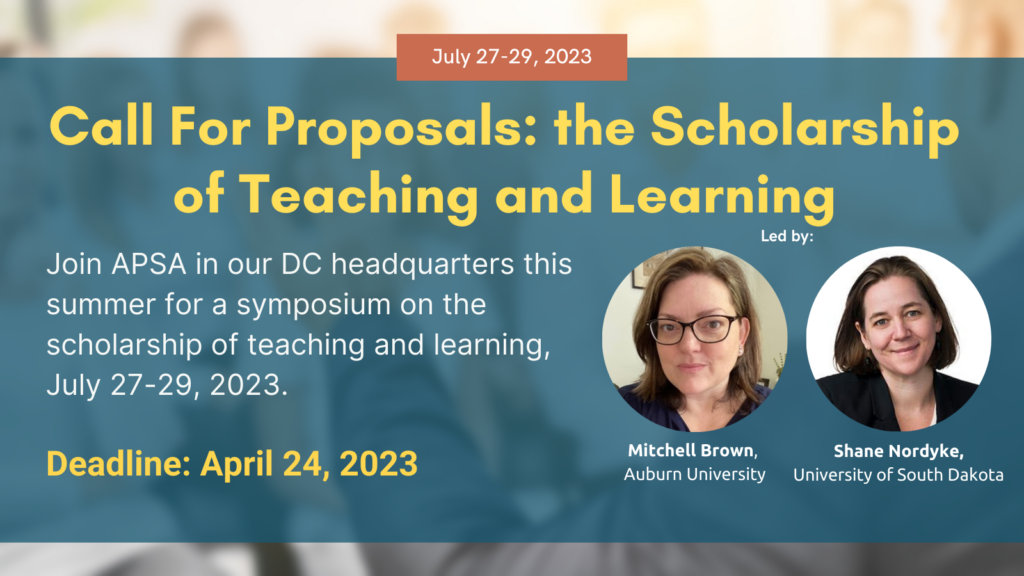
Application Deadline Extended to – April 26, 2023 The American Political Science Association’s (APSA) Teaching and Learning program is pleased to announce a call for proposals for 15 political scientists to participate in a three-day teaching and learning symposium July 27-29, 2023 at APSA’s headquarters in Washington, DC. APSA’s teaching symposia provide a workshop environment…

Marjorie R. Hershey, Indiana University – Bloomington This essay will be added to the second edition of Dr. Hershey’s ebooklet, How to Teach American Politics (and Other Subjects) Effectively. While this work is in progress, APSA Educate is pleased to feature below. ChatGPT is a specific program of artificial intelligence using a dialogue format (which makes…

Political Science Educator: volume 26, issue 2 Interview This interview is the first installment in a Q&A series focused on education and politics. In November, Matt Evans (Northwest Arkansas Community College, Political Science Educator Co-editor) interviewed Will Creeley (the Legal Director of the Foundation for Individual Rights and Expression[1]) on the political struggle for First…
Political Science Educator: volume 26, issue 2 Research Notes Ryan Gibb, Baker University Though the “meme”-ification of politics has its critics (Kulkarni 2017, Bulatovic 2019), memes can be useful tools. Similar to cartoons or comics, they illustrate concepts and generate conversation by both demanding that the author concentrate complicated thoughts into readily intelligible images with…