Political Science Educator: volume 29, issue 2
Reflections
By Judithanne Scourfield McLauchlan (jsm2@usf.edu)
The “10 Steps of No Blame Problem Solving” method from the Citizens Campaign[1] is a useful tool for teaching students how to work with policy makers to solve community problems. The Citizens Campaign Founder, Harry Pozycki, authored the text Citizen Power (Rutgers University Press) and worked with scholars and educators to develop the No Blame Problem Solving curriculum that includes a textbook, videos, and certificate program for college students, provided at no cost on the Citizens Campaign website.[2]
Integrating the “10 Steps of No Blame Problem Solving” method into a class project helps students develop a number of skills that are critical as they prepare to enter the workforce, such as working together in groups, research and writing, oral communication, and .[3] Moreover, this civic leadership project prepares students to be active, engaged, and effective citizens by helping them learn how to engage effectively with the policy-making process.
I have incorporated a “Civic Leadership” project based on the Citizens’ Campaign Power Civics program in several different courses, including Leadership and Civic Engagement, State and Local Government, Florida Politics and Government, Community Leadership Practicum, and American National Government. In this article I will share best practices for how to integrate this “10 Steps of No Blame Problem Solving” method into the curriculum as a class project and will offer suggestions for incorporating into a broad array of public policy courses. [4]
The Citizens Campaign[5] curriculum can be integrated into a variety of courses across the disciplines, and it is customizable to different local contexts and diverse communities. Students achieve a deeper understanding of local government institutions as they determine where their solution might be advanced, and they develop a sense of self-efficacy as they learn to develop evidence-based solutions for their communities. The Citizen Campaign’s Power Civics is a free curriculum that includes free videos and textbook, and students earn a certificate upon completion of all of the modules and .
Based on the Citizen’s Campaign curriculum, I developed a “Civic Leadership Group Research Project” assignment. The objective of this assignment is to help students to develop their citizenship skills and policy-making chops by becoming certified in the Leadership and No Blame Problem Solving curriculum. Students worked together in groups to identify a public policy problem, research possible solutions and best practices, develop policy solutions based on those best practices, and then present their solutions to the relevant local policy-making body (City Council, School Board).[6]
This is a scaffolded assignment, where students take on difficult tasks outside their comfort zone and they receive specific instructions on each of the skills that they need (Fisher and Justwan 2018, 63). To implement this project, I first have students complete the online Citizen Campaign’s Power Civics course, completing the modules and earning the certificate.[7] Second, I have students complete my Civics Project .[8] Originally developed for my American National Government class, this worksheet helps students develop their own local government “manual.” The Civics Project Worksheet Assignment questions guide students as they identify who is on their local school boards, county commissions, city councils, etc., when those government bodies meet and the process for participating in the public comment period. Third, given that one of the project deliverables is a group research poster presentation, students are required to earn our university library’s research poster “badge” by completing an online module in Canvas, our Learning Management System (LMS). The University of South Florida library also has helpful videos and research poster templates available on its website.[9]
To form the research groups and elicit student preferences on policy issues or group-mates, I created a survey through Google forms for students to complete. After reviewing the student survey responses, I assigned four students to each group and then posted these groups (along with member contact information, with permission) in our LMS. Depending on your course, you may wish to develop the assignment with specific policy topics relevant to your Student Learning Outcomes.
Once the students were organized into research groups, they were assigned a series of six exercises designed to assist them with working through the “10 Steps of No Blame Problem Solving,” from initial brainstorming to the proposal presentation with the relevant local government body (school board, county commission, city council, etc.)[10]:
- Identify your priority issue & drill down to an issue of passion. It should be as specific as possible, yet a solution should benefit the community as a whole.
- Submit a public records request and find out how the current policy works.
- Conduct research to find policies that have succeeded in communities like yours, so that the solution you propose will be evidence-based.
- Shape your solution to fit local circumstances and build on existing policy.
- Do a cost analysis to make sure your solution is cost-effective (ideally cost-saving, or at least budget neutral; if it’s not, make a plan for raising money from grants or fundraising).
- Do the Doable: consider phasing, piloting, and other implementation strategies.
- Get support from experts by sending them a brief report on the information you’ve gathered so far–not just on content but on what players to approach first and how to approach them.
- Write your solution in the form of a legal document, using the current policy as a model.
- Present your solution respectfully to the appropriate local power center, using the No-Blame approach.
- Pursue the adoption of your solution respectfully, using the No-Blame approach.
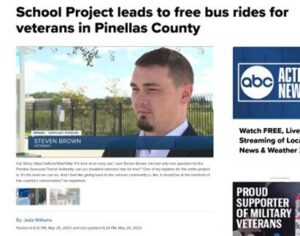
Over the years, I have attended as many of the public meetings as possible to observe my students’ presentations of their policy. I was especially proud of the group from my Florida Politics course (2023) who were concerned about veterans, specifically, veterans’ ability to access healthcare services at the local Bay Pines VA Hospital. Ultimately, students in this group were able to secure free bus transportation for the 90,000 veterans in Pinellas County, Florida through their work with the PSTA, the Pinellas Suncoast Transit Authority (Cimitile, 2023; Tracy, 2023; Rojas, 2023; Williams, 2023).
This community leadership project can be adapted as an assignment across a broad range of disciplines and course topics, and it is customizable to different local contexts and diverse communities. Students enrolled in any course with a policy focus – from environmental science, to public health, to criminal justice, to education – would benefit from an assignment that incorporates the Citizen’s Campaign “10 Steps of No Blame Problem Solving” method.
This series of exercises guides students through the research and writing process to develop policy solutions in their area of study and to develop their oral presentation skills as they present those policy solutions to the relevant policy-making bodies. In the previous example, the transportation officials invited my students to attend follow-up meetings and to engage with the staff who were going to be responsible for implementing the policy change. This kind of experiential learning opportunity provides another opportunity for students to make community connections that lead to internships and that further their career goals in their chosen discipline.
Students who take the Citizen Campaign’s “10 Steps of No Blame Problem Solving” course and who work through those 10 Steps will come away from the project with improved research and writing skills, oral presentation skills, teamwork, networking skills, and more. As they learn more about the public policy issues and which policy makers (whether municipal, state, or federal) are responsible for those policies, students will learn to compromise (both in their groups as well as when presenting their solutions to elected officials) to bring about lasting . As a result of this experiential learning project, students develop the practical skills needed for active and engaged citizenship (Hillygus and Holbein, 2023; Villamen, 2025).
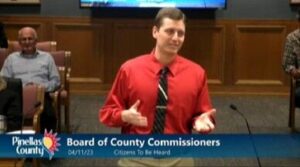
USF St. Petersburg student presenting at the Pinellas County Commission Meeting (Florida)
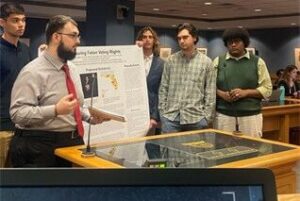
USF St. Petersburg students presenting at the Pinellas County Commission Meeting (Florida)
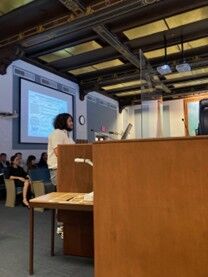
USF St. Petersburg student presenting at the St. Petersburg City Council Meeting (Florida)
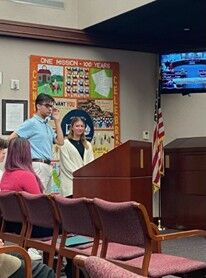
USF St. Petersburg students presenting at the Pinellas County, Florida School Board
USF St. Petersburg students presenting at the Pinellas Suncoast Transit Authority (Florida)
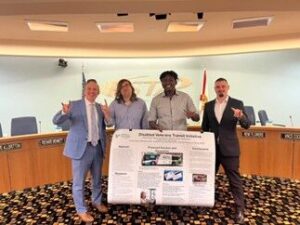
USF St. Petersburg students presenting at the Pinellas Suncoast Transit Authority (Florida)
References
Bloom, Amy B. 2020. “Building Civic Capacities in Schools and Communities.” National Civic Review 109(1): 6-15.
Cimitile, Matthew. 2023. “From Class Project to County Policy: How a Student’s Proposal Led to Free Bus Rides for All Veterans.” University of South Florida St. Petersburg News [website], June 1. https://www.stpetersburg.usf.edu/news/2023/how-students-proposal-led-to-free-bus-rides-for-veterans.aspx
Dewey, John. 1916. Democracy and Education. New York: Macmillan Co.
Fisher, Sarah, & Justwan, Florian. 2018. “Scaffolding assignments and activities for undergraduate research methods.” Journal of Political Science Education 14(1), 63-71.
Hillygus, D. Sunshine and John B. Holbein. 2023. “Refocusing Civic Education: Developing the Skills Young People Need to Engage in Democracy.” Annals of the American Academy 705(1): 73-94.
Mariani, Mack and Philip Klinker. 2009. “The Effect of a Campaign Internship on Political Efficacy and Trust.” Journal of Political Science Education 5(4): 275-293.
Martens, Allison and Jason Gainous. 2013. “Civic Education and Democratic Capacity: How Do Teachers Teach and What Works?” Social Science Quarterly 94(4): 956-76.
National Association of Colleges and Employers (NACE) Career Readiness Competencies: https://www.naceweb.org/career-readiness/competencies/career-readiness-defined#competencies
Pozycki, Harry S. 2020. Citizen Power: A Citizen Leadership Manual Introducing the Art of No-Blame Problem Solving. New Brunswick: Rutgers University Press.
Rojas, Josh. 2023. “Free PSTA Bus Rides for Pinellas Veterans Begin This Month.” Bay News 9 [website], November 1. https://baynews9.com/fl/tampa/news/2023/10/24/psta-bus-rides-veterans
Throntveit, Trygve, David J. Roof, Anand Marri, and Ronald P. Mahurin. “Educating Undergraduates for American Democracy: The Third Way Civics Approach.” Michigan Journal of Community Service Learning 29(2): 14-39.
Tracy, Kailey. 2023. “SunRunner Hopes to Add Three New Buses as it Gains Popularity.” Fox 13 Tampa Bay [web site], May 23. https://www.fox13news.com/news/sunrunner-hoping-to-add-three-new-buses-as-it-gains-popularity
Villaman, Natalia. 2025. “Cultivating Political Efficacy: Facilitation as a Catalyst for Democratic Education and Civic Competence.” Journal of Civil Society 21(1): 1-20.
Williams, Jada. 2023. “School Project Leads to Free Bus Rides for Veterans in Pinellas County.” ABC Action News 9 [web site], May 23. https://www.abcactionnews.com/news/region-pinellas/school-project-leads-to-free-bus-rides-for-veterans-in-pinellas-county
—
Judithanne Scourfield McLauchlan is Associate Professor of Political Science, Lead Instructor for the USFSP YMCA Civic Fellows Program, and Founding Director of the Center for Civic Engagement, University of South Florida St. Petersburg.
[1] https://thecitizenscampaign.org/
[2] https://thecitizenscampaign.org/
[3] See, for example, the NACE Career Readiness Competencies: https://www.naceweb.org/career-readiness/competencies/career-readiness-defined#competencies
[4] An earlier version of this article was presented at the 2023 Florida Political Science Association Annual Meeting. Dr. McLauchlan would like to thank the Citizens Campaign (especially David Sherwin and Dr. Joanna Kenty) and Dr. Erin Richards of Cascadia College for her workshop at the American Political Science Association in Montreal in 2022.
[5] https://thecitizenscampaign.org/
[6] Collaborating with local governments works best for this assignment for many reasons. These government entities meet year-round, making it more likely that students will be able to present their proposals in person during the course of the semester. For example, in Florida the legislative committees meet in the Fall, and the 60-day legislative session is in the Spring. State Representatives can only file up to seven bills each session. There are more limitations on advancing policy ideas in the state legislature than in local governments. In Florida there is always a public comment portion of the meetings, ensuring that students can present their proposals in person and on the record. As such, students learn more about the scope and responsibility of the local governments and the role they play in their everyday lives. Local governments tend to be less polarized and more focused on solutions than national political discourse, and this has led students to report a greater sense of political efficacy in their post-project surveys.
[7] Students should be able to complete the course in about two hours. Students appear motivated by the opportunity to earn a credential that gives them skills that can be used in the workforce.
[8]All project assignments available upon request. Please contact the author at jsm2@usf.edu.
[9] See the libguide at https://guides.lib.usf.edu/c.php?g=1412999&p=10465619
[10] Special thanks to Drs. Erin Richards and Joanna Kenty for the workshop presentation at the American Political Science Association Annual Meeting in Montreal in 2022. I took their workshop materials and adapted them for my courses. Assignments and exercises are available upon request. Please email the author at jsm2@usf.edu.
Published since 2005, The Political Science Educator is the newsletter of the Political Science Education Section of the American Political Science Association. As part of APSA’s mission to support political science education across the discipline, APSA Educate has republished The Political Science Educator since 2021. Please visit APSA Educate’s Political Science Educator digital collection.
Editor: Matt Evans (Northwest Arkansas Community College)
Assistant Editor: Colin Brown (Northeastern University)
Submissions: editor.PSE.newsletter@gmail.com